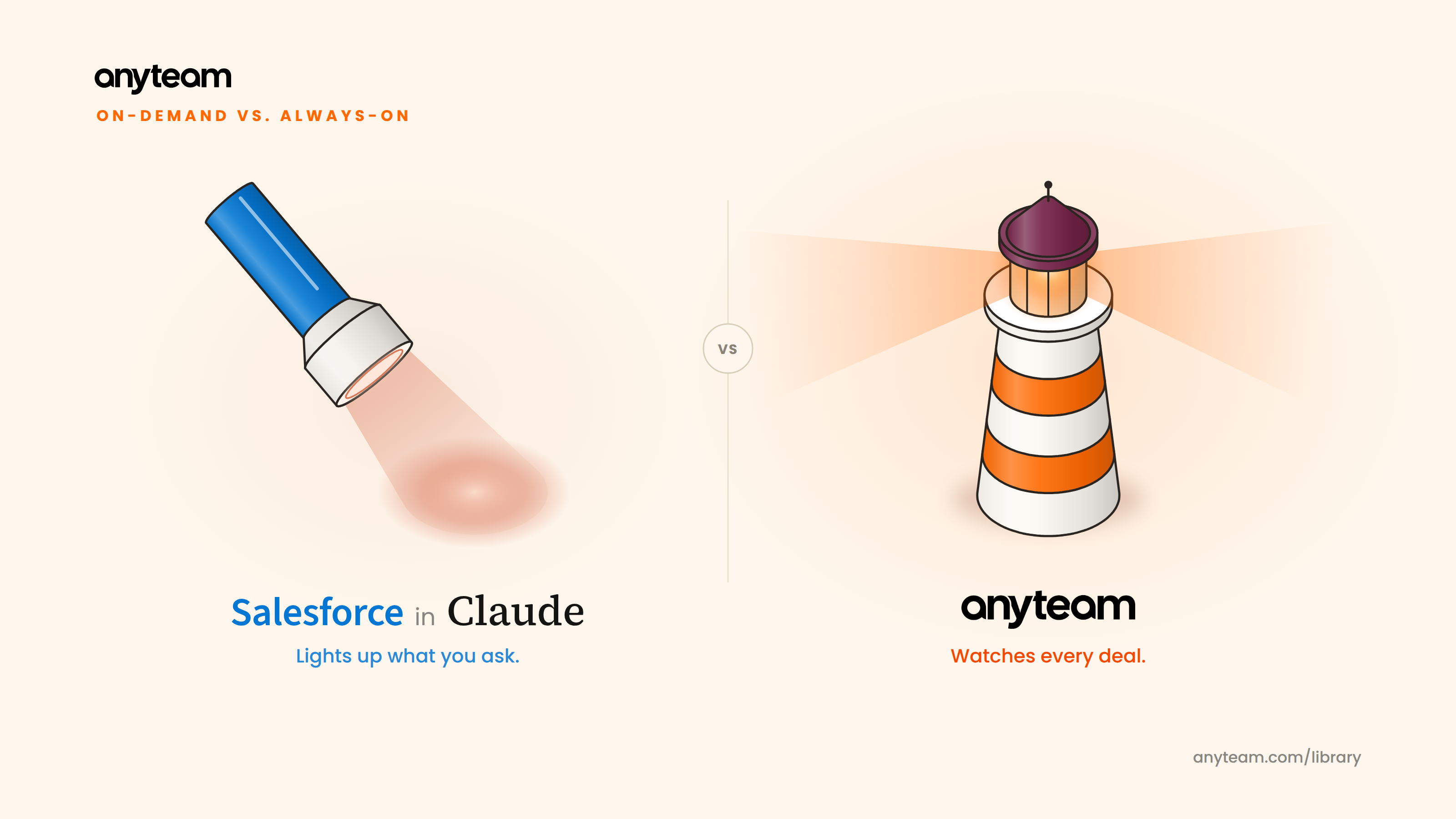
Salesforce in Claude gives sellers a capable AI that can reason over Salesforce and other company context made available to it. AnyTeam is an always-on AI sales workforce built to continuously capture how a sales organization operates, retain what happens across deals, and use those accumulated learnings to inform future decisions and actions.
Salesforce in Claude reasons over company context when a seller asks it to do something. AnyTeam continuously builds organizational sales memory and uses it to reason, surface risks, and execute work.
The key distinction is how company context becomes company-specific understanding, how that understanding improves over time, and whether the AI waits to be asked or continuously operates around the sales motion.
At a glance
| Capability | Salesforce in Claude | AnyTeam |
|---|---|---|
| Primary purpose | Bring Claude reasoning into Salesforce workflows | AI workforce for revenue teams |
| Company context | Salesforce and supported enterprise context | CRM, email, meetings, Slack/Teams, calendar, docs |
| Company knowledge | Uses rules, instructions, data, and knowledge made available to Claude | Continuously connects organizational activity into persistent sales memory |
| Historical deal reasoning | Reasons over historical information available to Claude | Retains deal patterns, actions, outcomes, and organizational learnings |
| Organizational memory | No equivalent persistent cross-deal model publicly documented | Capture → Connect → Compound |
| Interaction model | Seller asks → Claude reasons → response/action | Monitor → recognize → understand → decide → execute |
| Deal intelligence | Analyzes deals using available Salesforce context | Connects current signals to company history and learned patterns |
| Execution | Supported Salesforce actions with controls | Executes workflows across connected revenue systems |
| Best fit | Teams wanting Claude inside Salesforce workflows | Teams wanting always-on sales memory and execution |
What is Salesforce in Claude?
Salesforce in Claude connects Claude to Salesforce accounts, opportunities, pipeline, and supported enterprise context.
It includes 37 pre-built sales skills covering workflows such as account research, meeting preparation, pipeline review, renewals, follow-up, and CRM work. Those skills give Claude instructions about the information to retrieve and the task to perform.
A typical workflow looks like:
Seller asks → Claude selects the relevant skill → retrieves company context → reasons over it → returns an answer, draft, or supported action
The seller determines when Claude enters the workflow.
What is AnyTeam?
AnyTeam is an AI workforce built specifically for revenue teams.
It connects the systems where sales activity occurs and builds persistent memory across accounts, opportunities, buyers, reps, conversations, actions, and outcomes.
Its model is:
Capture → Connect → Compound
Instead of treating every interaction as an isolated request, AnyTeam is designed to retain what happens, connect actions to outcomes, and apply what the organization learns to future sales situations.
How company knowledge gets used
Both systems can reason over substantial company context.
Salesforce in Claude can use Salesforce data, connected information, business rules, instructions, and organizational knowledge that have been made available to Claude.
AnyTeam continuously connects the activity and outcomes of the sales organization into persistent sales memory.
Consider an organization that has learned:
Deals above $4M that reach late stage without an executive sponsor and then push their close date twice have historically been much more likely to end in no-decision.
Claude can use that learning when it exists in information or instructions available to it. AnyTeam is designed to preserve these relationships as the organization operates:
Situation → action taken → outcome → learning retained → applied to future situation
That allows previous sales outcomes to become part of how future deals are interpreted.
Same deal. Different organizational grounding.
Consider a $4.8M enterprise opportunity.
The deal is late stage. There is no confirmed executive sponsor or finance involvement. The close date has moved twice. Procurement is raising implementation concerns. The buyer says the organization is “still getting internal alignment.”
Salesforce in Claude can reason across those facts and identify meaningful deal risk. A reasonable interpretation could be:
“This opportunity has several risk indicators: limited executive engagement, no finance involvement, repeated close-date movement, and unresolved procurement concerns. Consider engaging an executive stakeholder, multi-threading the account, and creating a clearer mutual action plan.”
That is useful deal intelligence.
Now imagine AnyTeam has accumulated this organization’s historical sales memory.
- It may recognize that previous $4M+ deals without executive sponsorship frequently ended in no-decision.
- It may remember another stalled opportunity that recovered after finance entered around a smaller Phase 1.
- It may know that procurement concerns in similar deals were symptoms of missing executive ownership rather than documentation problems.
- It may also recognize that the organization’s strongest reps responded to “the buyer is still getting aligned” by securing executive involvement and creating a dated mutual action plan.
The current deal is being interpreted through what the organization has previously learned: similar situations, actions taken, outcomes, and the behaviors associated with successful recovery.
That accumulated memory creates a more company-specific conclusion:
“This combination resembles previous deals in this organization that ended in no-decision. Similar opportunities recovered when finance entered around a smaller Phase 1, executive sponsorship was established, and vague internal alignment became a dated mutual action plan.”
The current information is the same. The difference is the organizational experience informing the reasoning.
Organizational memory compounds
Every won, lost, slipped, recovered, or qualified-out opportunity contains information about how a sales organization operates.
Suppose the team responds to this deal by bringing finance into the opportunity, securing an executive sponsor, reducing the initial scope, resolving procurement concerns, and eventually closing. That creates another example of:
Situation → intervention → outcome
A failed intervention matters too.
Over time, this can build a more specific understanding of which signals matter, when they matter, which interventions tend to work, which repeatedly fail, and how top-performing reps respond.
For CROs evaluating deal intelligence, revenue intelligence, or AI sales tools, the question becomes whether historical information simply remains available to query or continuously influences future sales decisions.
On-demand assistance vs. always-on operation
Salesforce in Claude begins when a seller gives Claude a task or asks a question.
Seller asks → Claude reasons → Claude responds or acts
AnyTeam is designed around a different operating pattern:
Monitor → recognize → understand → decide → execute
That matters because reps do not always know what question they should ask. A seller may never think to ask:
“Compare this $4.8M opportunity against every large deal that pushed its close date twice without executive sponsorship.”
An always-on system can identify the combination of signals itself and surface the issue.
For organizations evaluating sales automation, sales productivity tools, or sales execution software, that changes the role AI plays: from something available when requested to something continuously operating around the sales process.
From understanding to execution
Deal intelligence becomes more valuable when it changes what happens next.
For the $4.8M opportunity, AnyTeam’s tested workflow translated the risk into concrete work: alerting the manager, creating a deal-risk briefing, identifying missing finance and executive stakeholders, drafting outreach, creating follow-up tasks, preparing CRM changes where integrations permit, and monitoring whether the intervention works.
Understanding → decision → execution → outcome
AnyTeam also distinguishes between actions it can execute directly, actions requiring human approval, and actions unavailable because a required integration is missing.
Salesforce in Claude also supports sales workflow automation through its pre-built sales skills and supported Salesforce actions. The distinction is therefore broader than whether either product can take action. It is whether the work begins from a user request or from continuous monitoring informed by persistent organizational memory.
Which is better suited to your sales organization?
Salesforce in Claude is suited to organizations centered on Salesforce that want sellers to use Claude for research, preparation, pipeline analysis, follow-up, and supported CRM workflows.
AnyTeam is suited to organizations that want AI continuously operating around their sales motion, retaining what happened across deals, applying historical outcomes to new situations, and coordinating execution across the revenue stack.
AnyTeam’s value also depends on integrations and accumulated company history. Missing connections limit what it can see or execute, and consequential actions may still require human approval.
Bottom line
Salesforce in Claude gives sellers a Claude-powered interface for reasoning over Salesforce and other company context that has been made available to it.
AnyTeam is designed as an always-on AI workforce that continuously builds compounding memory of how your organization sells, and applies those learnings to reasoning and execution.
The deciding question is: how should your organization turn the sales context it already has into better decisions and actions — through an AI sellers invoke when they need help, or through a system continuously learning from and operating around the sales motion?
FAQ
What is the difference between AnyTeam and Salesforce in Claude?
Salesforce in Claude lets sellers use Claude to reason over Salesforce and available enterprise context. AnyTeam continuously builds organizational sales memory and applies it to proactive reasoning and execution.
Can Salesforce in Claude analyze deals and pipeline?
Yes. Its sales skills include deal, pipeline, account, meeting, and CRM workflows.
Can Salesforce in Claude use historical deal information?
Claude can reason over historical information available in its connected context. Public documentation does not currently describe the same persistent cross-deal organizational-memory model AnyTeam uses.
Does AnyTeam replace Salesforce?
No. AnyTeam works with CRM systems such as Salesforce rather than replacing the CRM as the underlying system of record.
Can AnyTeam and Salesforce in Claude work together?
Yes. Salesforce can remain the system of record while AnyTeam operates as a sales-specific memory, reasoning, and execution layer across the broader revenue stack.