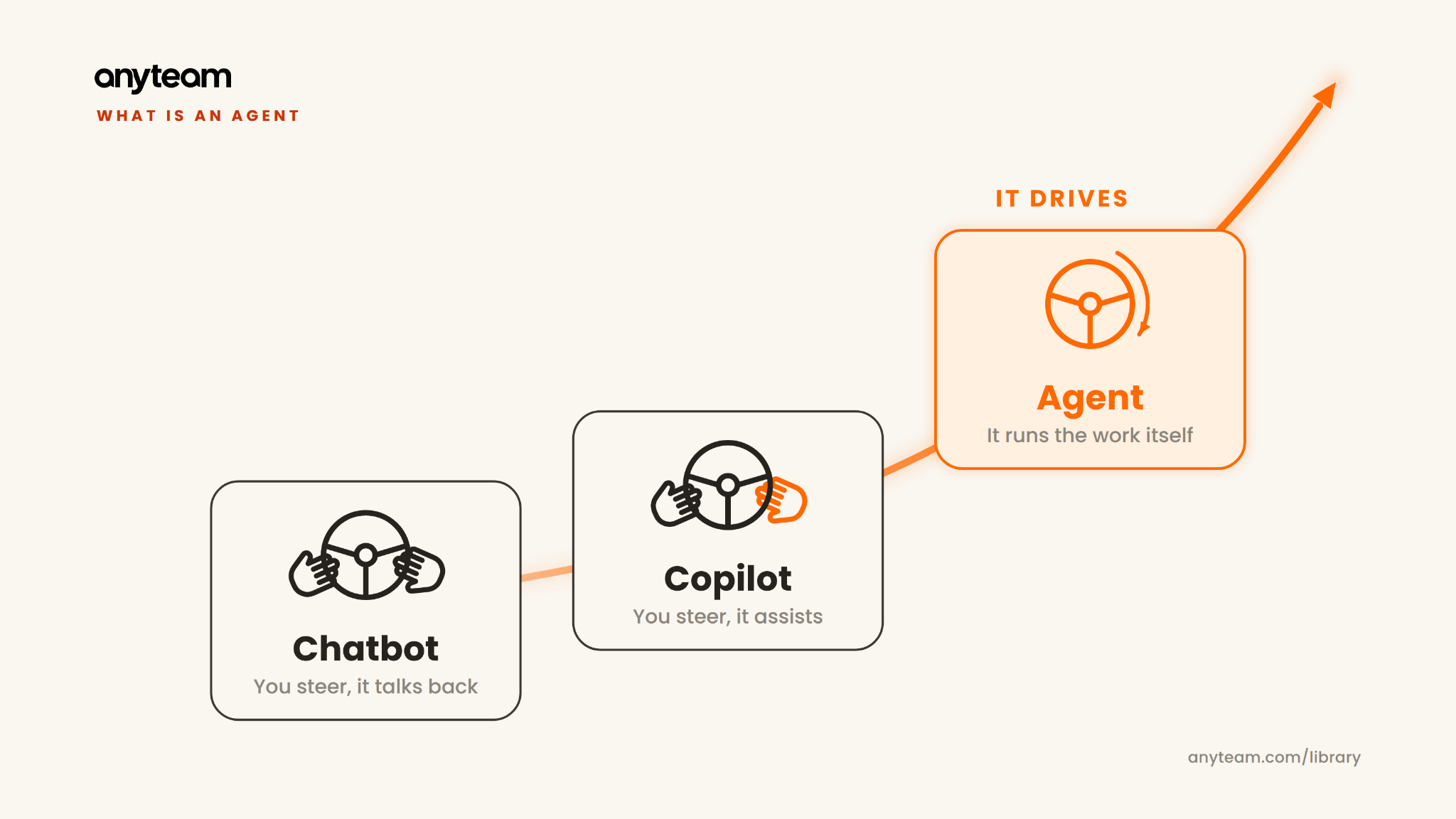
An agent does the work that moves a deal forward — drafts, prep, follow-ups, risk flags — grounded in a memory of your product, process, and customers that keeps updating as the deal moves.
Chatbot vs. Copilot vs. Agent
Since the launch of ChatGPT in November 2022, we’ve seen the deployment of chatbots, copilots, and agents. Each of them is different, and each serves a different purpose for users.
| Type | Description | Who initiates | What it does |
|---|---|---|---|
| Chatbot | Provides responses to questions via a chat box | The user prompts a question | Provides a response |
| Copilot | Assists with specific tasks on demand or upon request | The user or the copilot initiates a task, typically singular | Completes a task |
| Agent | Handles the execution of work autonomously | The agent initiates based on triggers or signals | Executes work, often multi-step: research, review, creation, communication |
Example: How an agent assists a deal
Joanne has just completed the business case review, and the deal is moving into technical validation. Between now and the close date she has to gather the as-is and to-be requirements from the prospect (where GE’s current setup stands, and what the new one has to do), brief her internal team, prepare a demo and technical walk-through, organize a meeting with GE’s security and IT team, and prove the product meets the technical requirements.
Here is Joanne’s list, run through an agent that holds the full account in memory:
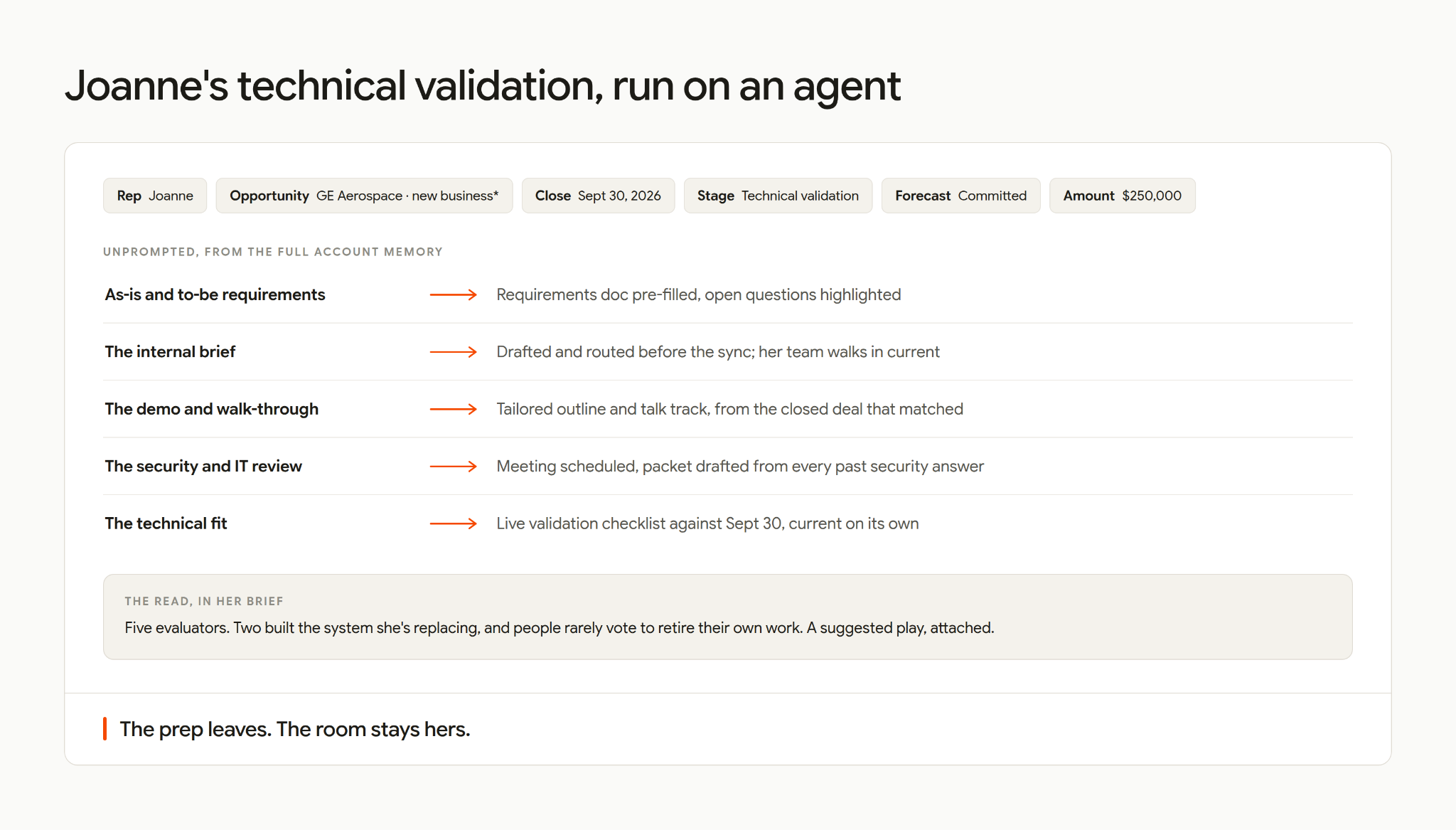
And one more thing, the kind nothing else in the stack surfaces: the agent tells Joanne the room. Five evaluators, two of whom built the system she’s replacing, and people rarely vote to retire their own work. That read lands in her brief before the first technical session, with a suggested play attached.
Every row in that table used to be Joanne’s evening. With the preparation done for her, her hours go where only she can go: the room, the relationships, the read on the five people deciding. The human part of selling stays hers.
Where AnyTeam fits
An agent is only as good as the memory it runs on, and in sales, memory is the hardest part of the job. Think of it the way a person works: one brain holding everything learned, driving every action. The agents are the hands. Compounding Memory is the brain.
Each hand runs the same loop on every deal, against that shared memory — it notices a change, recalls what worked before, does the work, learns from your edits, and hands off with nothing re-explained:
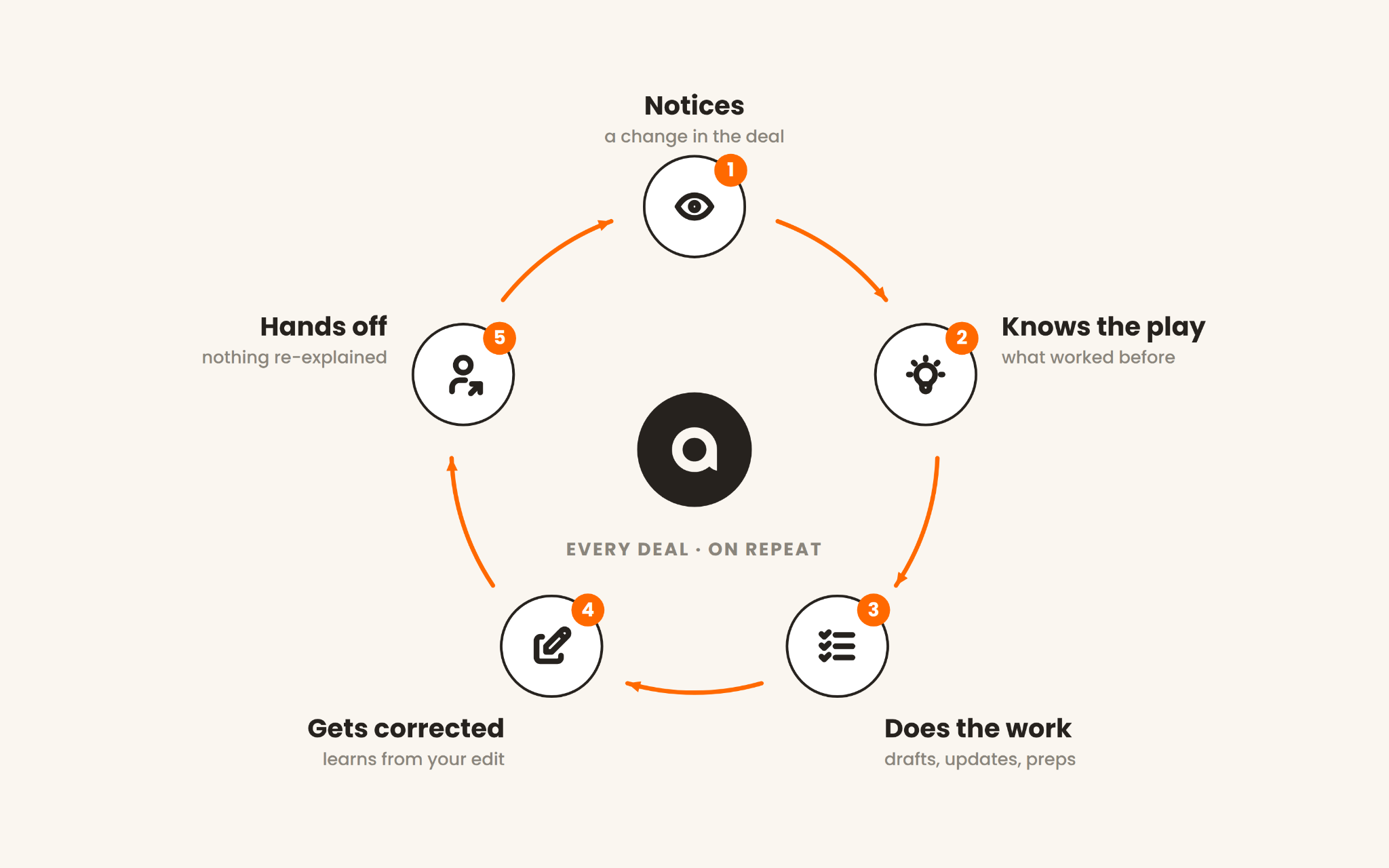
That’s what makes them a team instead of a collection. The prep agent, the risk agent, and the artifact agent all work against the same live account picture — the one that already holds the objection from month two and the play that closed the last deal like this one. Their deliverables come out grounded in what’s true right now, not in whatever got pasted into a prompt. So the rep’s attention goes where it belongs: selling, being in the room, earning the buyer’s trust. And because it’s one memory, the tenth deal starts with everything the first nine learned.
AnyTeam is the AI workforce for revenue teams: one brain, many hands. It sits on top of the tools your reps already use — Salesforce, Slack, email, calendar — and aggregates everything in them into one account memory. Every deliverable is grounded in the motion of the deal, every deal like it, and the current state of your product. And because the memory belongs to the org, none of it leaves when a rep does.
FAQ
What is an agent?
An agent is software that pursues a goal across multiple steps on its own: reading deal signals, deciding what’s needed, and completing the work — follow-ups, CRM updates, call prep, risk flags — without waiting for a prompt.
What’s the difference between an agent and a chatbot?
A chatbot answers questions one at a time and waits for you to drive. An agent is given an objective and executes it across multiple steps and systems, including work that happens while you’re not watching.
What’s the difference between an agent and a copilot?
A copilot assists with the task you’re already doing, in the moment. An agent works toward goals on its own, in the background, across every deal at once.
Do agents replace reps?
No. Agents take the work around selling: the admin, prep, research, and follow-up. Judgment, relationships, and the human part of closing stay with the rep.
What does an agent need to work well?
Three things: real grounding in your calls, CRM, and deal history; guardrails that keep humans in control of customer-facing actions; and a memory layer underneath it, so it learns from every deal instead of starting from scratch.