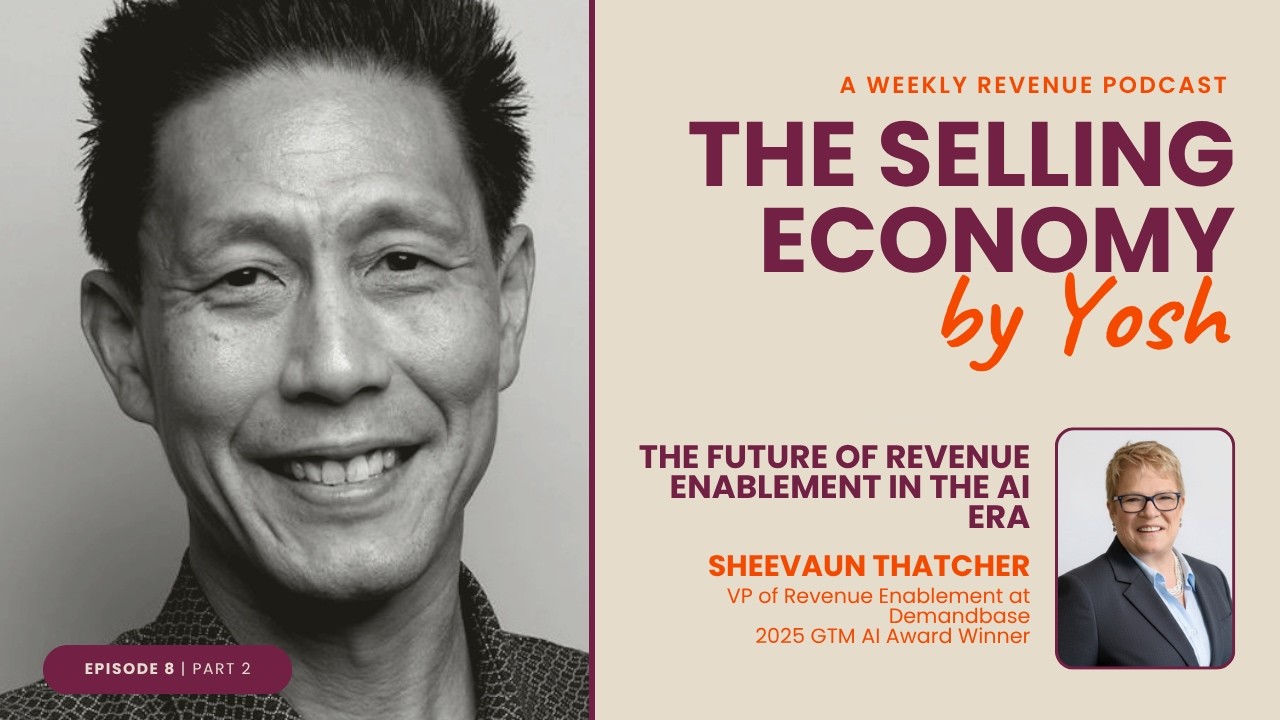
Key takeaways
- AI collapses the time it takes to build enablement material, but the judgement behind the questions is what makes the output usable: twelve hours of tooling on top of decades of experience.
- People still buy from people. AI helps you focus, generate ideas and connect the dots; it does not read the room or carry a relationship.
- Identical AI-written outreach arriving from different companies destroys the trust personalisation was meant to build, and gets deleted unread.
- Enablement is the hub of the wheel. It is the one function that talks to every team, which puts it in the best position to join up what the rest of the company is doing separately.
Chapters
- 00:36Welcome Back: Revenue Enablement in the AI Era
- 01:03How AI Is Transforming Enablement at Demandbase
- 03:09Why Human Trust Still Matters in B2B Sales
- 03:39The Problem With Generic AI-Generated Outreach
- 04:48Human Connection and the Role of Enablement
- 05:52Career Advice for Aspiring Enablement Professionals
- 08:39AI vs. Critical Thinking: Why Both Matter
- 09:24The Future of AI in B2B Selling
- 11:10Asking Better Questions and Uncovering Customer Needs
- 11:52Rapid Fire: Sheevaun’s Favorite Sales Moment
- 12:39Lessons From a Value-Based Sales Leader
- 13:45Sheevaun’s Recommendation for a Future Guest
- 14:44Closing Thoughts
Read the full transcript
0:01 Somewhere out there right now, a sales rep is walking into a meeting and sitting across from them is a buyer who already knows more than they do. That's no accident. AI has created the biggest shift in selling in 30 years. And millions of sellers and the leaders behind them are living it every single day. I'm Yosh and this is the selling economy, a show about the people in the middle of that shift and the stories of what's working now and the lessons that they've learned along the way. The selling economy is presented by any team, the team behind every rep. Welcome back to the selling economy podcast. I'm Yosh still here with Siobhan Thatcher. Part one was about Siobhan's journey into enablement as well as her framework called the four pillars and R2 and four.
Welcome Back: Revenue Enablement in the AI Era
0:48 Let's dive right in. So you mentioned Demandbase. What are you working on now at Demandbase? What's exciting? What's interesting? What's new there specifically to the role of enabling? are kind of right in the throws of a sea of change. It's caused many fronts with AI. Anything you can share that'd be The change even in the last year has been phenomenal. If you had asked me a year ago what enablement was, I would be very clear on where we do all the pieces and how that all fits. And now with AI and the advancements with it and the innovations that are coming with it, it's changing not only how we support our customers, right, our internal customers, what do we do for them? But it's also changing our roles spectacularly. What used to maybe have taken us a long time to come up with what are what are the right what are the gaps that we're seeing? How are we going to fill it?
How AI Is Transforming Enablement at Demandbase
1:34 What are we going to do from a training perspective? What kind of course could we run? Let's do a trial, a pilot, all of that. You can get all of that together now in the matter of a couple of hours using the AI tools, right? You can get that all together so quickly. Now, again, as I said, it can be totally wrong. So, you've got to make sure that you got your brain involved, which is where the enablement will never apparently some conference a couple of months ago, somebody's like an replaced by AI. If you do that, good luck to you because that's no, you're going to have a disaster on your hands. But the are is it a great tool? Absolutely. Like I created this master class on discovery. It ended up being 150 page guide book but so dense and so full of all this incredible information. And I used Claude to create it and it took about 12 hours.
2:22 And I somebody asked me well that's great. And I said well 12 hours and 45 years of business experience because I knew when I asked the questions what questions I needed answers and if the answer came back and it didn't seem right it was like no that's not what I was asking. Right. And so but putting it together in 12 hours that could have taken me months, two or three months. So the timing itself has been phenomenal. I think enablement we are going to become the masters of how to combine the human element and the AI element to remember that who we're selling to are still people. AI does not sell to people. People sell to people. People buy from people. AI as a tool set to help you focus, give you ideas, help you connect the dots is amazing. as long as the trust factor is there.
Why Human Trust Still Matters in B2B Sales
3:09 I think that's an important part of kind of the world that that we operate in. We're both in B2B. We both believe in the thesis that sellers and teams of go to market folks will not be replaced by AI. Can you do more with AI? Absolutely. But that element of trust and that relationship, the human aspect is critical to building relationships with customers, to asking good questions and having the customer prospect be receptive to those questions and then building kind of long-term trust that will build ideally and hopefully for companies durable revenue. Yeah, I think that's really important. I I think I was telling you this one day a couple months ago, I got 10 emails all within about an hour, all from different companies. But the emails themselves was a paragraph and then a sentence and they were identical. Identical words, identical punctu everything was identical except for the company name.
The Problem With Generic AI-Generated Outreach
3:58 And I thought, okay, now it's AI slop. And so the trust factor means that most days I get in the morning and do control A and delete. I even look at the stuff that comes into my email because it's just garbage. It doesn't it's personalization. I'm like that's not Yeah. And that's what why we call this podcast the selling economy. And but we're really focused on is there's going to be a new way of of how kind of selling organizations are equipped to build trust with customers. And of course behind the scenes, the teams that we manage and orchestrate will utilize AI, but at the end of day, it's that human person who is building that relationship at the end of day, moving that deal forward. You're not going to have an AI move a deal from stage four to stage seven. And you're not going to have AI go and close a deal, especially when you're talking about kind of B2B enterprises where you're looking at upwards of 25 to 100 to even multi-millions of dollars on the Yeah, these are complex sales and these are complex humans and an AI is not going to be able to create that matrix appropriately where the human brain has the ability to take in all of the senses, right?
Human Connection and the Role of Enablement
5:00 has the ability to take in the intuition and reading body language and all of that other kind of stuff that makes me understand like is Jeff locked in on this conversation or is he over here pretending he's not on his phone right I mean these are the kinds of things that AI just isn't going to get you have to understand humanto human communications and that's really I think where enablement is going to have the biggest impact there also because we are the only ones within a company that talks to everybody in the company we're like the hub of the wheel because there's all these folks going out to all these groups who don't necessarily talk to each other, but we do. And so we can say, "Hey, what's going on over here? You guys need to be aware of that over here, and how can we make sure you're coming together? What can we do for our customers to put our customer first?" Because the thing is, everybody's doing the right thing. Everybody's trying to do the right thing, but if you're all doing the right thing in different directions, your poor customer has no idea what's coming at them.
Career Advice for Aspiring Enablement Professionals
5:49 And so enablement helps get that all back together again. Let's shift gears to your perspective on AI and we could take a couple lens on this. We talked a lot about kind of what's in it for enablement professionals, what's in it for sellers or selling teams, but maybe kind of take a step back and like if you are someone new into the profession and coming into this world of B2B and enablement, how do you break into the field? What skills do you need to learn? How would you mentor somebody new into the field? You've hired and managed lots of people that have had very successful careers. What would be your advice to people that are interested in this profession? It helps if you've carried a bag. You don't have to, but it helps if you've carried a bag. That doesn't mean that you have to be a face-toface out on the street seller. Maybe you were BDR SDR in a support function. Whatever it is, you've interacted with customers.
6:36 That's the first thing. Second thing is that you have an understanding of what chaos looks like and that you're comfortable working within chaos, right? You just have to be because with the speed of innovation now, there is no way to get ahead of it. There's no way to have all the answers all the time. And what worked two weeks ago may not work now. things are changing that fast and you have to be really really comfortable with ambiguity. You have to be comfortable with I think this is the way to go. Let me talk to some of my peers. Let me talk to folks within the company. Let me talk to the sellers selling leadership. What do we all think about this approach? Okay, let's try it. Let's see how it goes. Let's set a timeline and have that kind of knowledge. You need to be able to understand human nature. I look for people that have an insight into how people react. Right? If you've got adult learning, great.
7:22 But you don't necessarily have to have adult learning as long as you've got intuition about how people are reacting and what they're doing. Right? I can teach body language. I can teach all of that stuff for things for you to take a look at. But there has to be a common sense approach. And now if you have not used AI and if you have not created something relatively complex with it yet as an enablement person, you're already behind the curve. If I was interviewing and somebody said, "Yeah, I played with Claude." I'd be like, "Tell me more. I've done some prompts and that's not enough. There is too much available right now easily found to upgrade skills that I would expect better skills than that coming in the door because that is the direction companies are going. Yeah, that's fantastic advice for anybody looking to get into the field or anyone just looking to break into sales is like if you're breaking into sales, you have to understand how AI is going to be utilized as part of your job and how you're also going to be able to cut through a lot of the noise and make sure that as a seller you're not producing what what you call as AI slop, right?
AI vs. Critical Thinking: Why Both Matter
8:24 Because that's what we don't want to teach people is doing more with sloppiness is not going to result in a better customer relationship, a closed deal. It's just kind of you're just doing what you mentioned is at the beginning of your day you go through all your emails and you have a bunch of slop and you just hit pound delete. Yeah. What we got to be very careful of is that we do not confuse AI with critical thinking. They are not the same thing, right? AI is a tool. AI allows dots to be connected very very quickly. AI will allow you to plum tons of information. Critical thinking is what's going to help you determine how to work with it properly. You have to have both. And so when I see sales people saying, "Well, I did all my stuff in AI and I created all my emails and tada." Well, you're all plumbing from the same pot, the same well, which means you and all your competitors and everybody else, someone like me is going to get those 10 emails on a day because somebody put in all of got all of a sudden got a hot lot of hits, a lot of likes, and so A's like, "Oh, this must be the way to go." And now all companies are using that.
The Future of AI in B2B Selling
9:23 It's like, no. Do you have a prediction on what AI means for sellers in the future? could be something kind of high in the sky or even a wish list of like hey if you had a dream and then a wish list of how things could work six months 12 months even multi-year down the road what would that be right now the models are getting better right the AI models are getting very very good there's better systems of memory there's better ability to interact with different systems it's becoming easier to prompt and even build what would be something that you see into the future around AI and those use cases or how you see AI being used and deployed within selling organizations It will become pretty standard in selling organizations for communication within groups. AI is going to connect and network and get all of that there. So, anybody can ask any of it, right? Still security and trust is still important, but all of that stuff's going to be connected.
10:11 I see that the folks that are going to be the most successful, who are the ones that are using AI to predict or to gather insights what their customers might not see. Because remember, whatever you've got access to, your customers do too. So the difference is going to be who's asking the question and what is the question that you're asking. That is where the folks that are using AI are going to excel because they're asking the unexpected questions to get the valuable answers. Right? There was a quote I love Jack Malcolm. I just saw this quote from him a number of years ago. Value is created when an undiscovered need meets an unexplained possibility. Unexplored possibility creating an unexpected spark of creativity. That is where the best sellers are going to be. They're going to think, I want to think outside the box. I want to go beyond what people are currently thinking of to say, what if you could do this?
Asking Better Questions and Uncovering Customer Needs
11:02 Right. Yeah. And it's all within the realm of helping the customer solve a business problem or undiscovered business problem that they haven't yet thought about. It's the humanto human communication that is going to make the difference. It's not going to be AI getting all the information for you faster than anybody else. If you're not asking the right questions, whatever you're getting is going to be slop. it's not going to be correct, right? So, you have to know the questions to ask or at have the creativity to think about it. And that means knowledge of your space. It means knowledge of your customer. It means knowledge of economics and finance and all of these things that are going on, right? How is that all affecting Javon, I love that. I love that. That is amazing. And I love ending with a quote. That's so powerful. I wanted to close with I have three rapidfire questions and you can answer them as oneliners, a sentence, or you could even go deep.
Rapid Fire: Sheevaun’s Favorite Sales Moment
11:51 So favorite sales moment. It could be a deal, a launch, something you've done over your career. What is that moment of of memory? Favorite sales moment was the first time I was involved in a million-dollar deal. Watching that seven figure thing hit. I was a sales engineer at the time and was involved in it. And that is really it was that deal that changed the way I looked at enablement because I recognized that just showing up and doing product and features wasn't going to do it. I was a partner with the salesperson and it was looking at what are they really after and it's when we answered that question when we got to the thing behind the thing that's when that deal closed and it was like yes this stuff works that's pretty cool number two your favorite sales rep manager sales leader that you've worked with and why how's that person helped you or helped the so I worked with a a sales guy a number of years ago up in Toronto whose name was David Yakman and when everyone else was selling product product he is selling applications.
Lessons From a Value-Based Sales Leader
12:49 And so his way of going to the customer was very much around this value thing, right? You don't want just a product, you want an application, you want a solution for something. And it was hearing him. He is the one that told me, and this has became a rule, that if you go into a room and you don't have the answers you need so that what you are presenting as a pre-salesperson addresses what their challenges are and you're just going up and showing up and throwing up, then you don't even open up your laptop until you get the answers that you need. So, not only was it selling applications versus product, but it was also ensuring I had all the answers that I needed and working together as a team and the accountability with the pre-salesperson and the saleserson together. That's really cool. So, my last question, and it could be this individual, but if you had one person to nominate to be a guest on the selling economy podcast, who would that be?
Sheevaun’s Recommendation for a Future Guest
13:41 It could be anyone in the GTM function. It doesn't have to be from sales or sales I think Demand Jen, she's amazing. Tell me more. Yeah, she was a challenger for a long time, was at Lavender for a while, went off and started her own. Jen Nuth, I can get her for some reason I'm blanking, but she goes by Demand Jen. And she did our keynote in February for our last kickoff. And not only was it a standing ovation for her for the keynote, but she did a workshop that changed the whole way that our outbound organization looked at the way that they were talking with customers. So, she is refreshing, she's funny, and she has a very, very strong and powerful perspective about how to show up different, how to be different, how to get to value, how to understand the cost of doing nothing, right? All that kind of stuff. I'd love an introduction to Jen because as a former CMO and demand genen was always such an important kind of interlock between sales, sales, and marketing enablement.
Closing Thoughts
14:34 It was a key function. So, excited to talk to Jen someday. Yeah, it's Jen Allen New Well, Siobhan, this was great. I wanted to really thank you for your time. Thank you for taking us through your background, your career. What's your perspective on AI today? That's the new selling economy that we're after. So, you know, I'm Yosh and until the next one. So, Siobhan, thank you again. Yes. Thank you very much. That's the show. If this one sharpened how you think about selling, send it to one person on your team who should hear it. Follow the selling economy wherever you get your podcast and subscribe on YouTube so you never miss a conversation. To learn more about Any Team, visit any team.com. New episodes every Wednesday. I'm Yosh.
15:20 So long. Thanks for