Uncovering the Sales DNA That Sets Great Sellers Apart (Part 1)
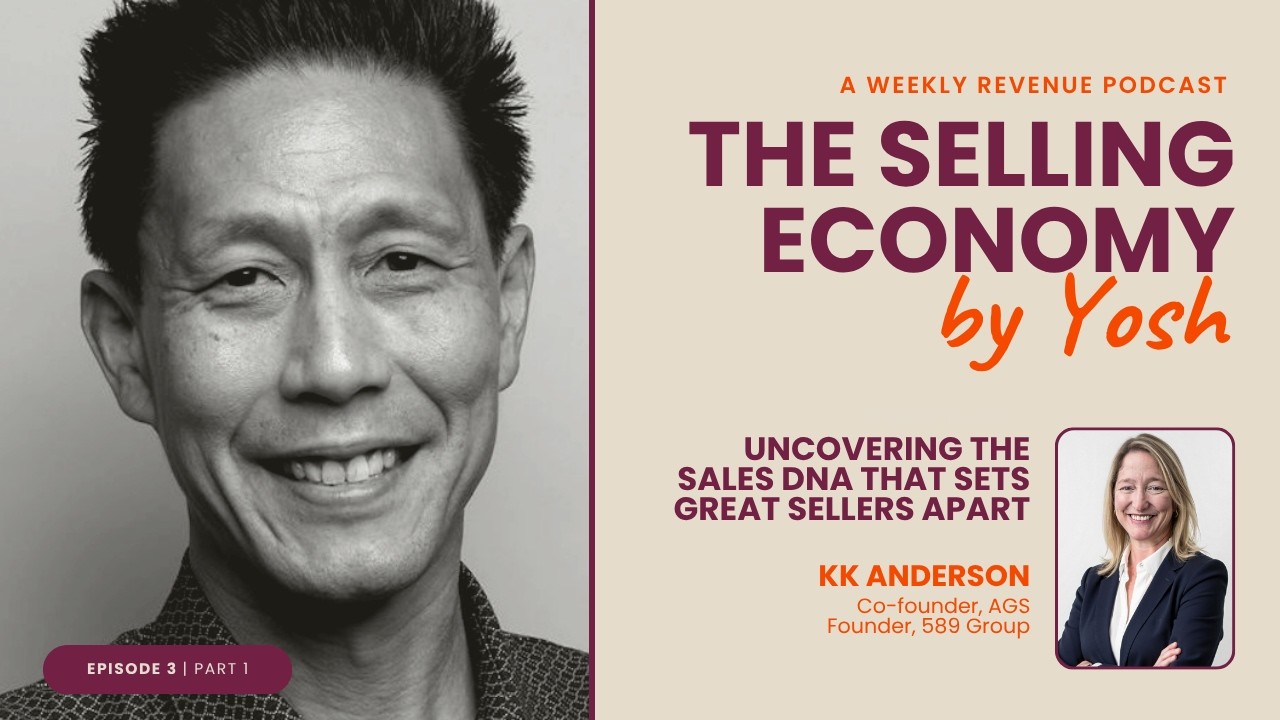
KK Anderson has evaluated more than 15,000 sellers. She explains the three layers of selling ability (tactical skill, sales DNA and the will to sell), why teams should diagnose before buying another AI tool, and the two-sale mentality: first the buyer has to say why they need to change, then why you and why now.
Key takeaways
- Selling ability is three layers, not one: tactical skill, sales DNA, and the will to sell. Most teams have never pulled them apart.
- AI collapsed the cost of competence, so the signals that used to separate a good rep from an average one no longer sort anyone.
- Diagnose before you buy another AI tool — tooling cannot fix a problem you have not located.
- The two-sale mentality: the buyer first has to say why they need to change, then why you and why now.
Chapters
- 00:00AI and the New Reality of Selling
- 00:59How AI Collapsed the Cost of Competence
- 03:34Why More Selling Time Is Not Enough
- 04:50Diagnose Before You AI
- 06:53The Skills AI Makes Easier
- 09:28Why Trust Still Matters
- 11:03The Three Layers of Selling Ability
- 14:27Grit, Accountability, and Eliminating Excuses
- 15:38Diagnosing Where Sales Teams Break Down
- 17:16The Two-Sale Mentality
- 19:41How AI Agents Can Accelerate Sellers
- 22:15Using AI Signals for Smarter Prospecting
- 23:44The Skills Sellers Need in an AI Era
- 25:40Will AI Take Sales Jobs?
- 27:02Building AI Into the Way We Work
- 28:03Humans and Machines Working Together
Read the full transcript
AI and the New Reality of Selling
0:00 Somewhere out there right now, a sales rep is walking into a meeting and sitting across from them is a buyer who already knows more than they do. That's no accident. AI has created the biggest shift in selling in 30 years. And millions of sellers and the leaders behind them are living it every single day. I'm Yosh and this is The Selling Economy, a show about the people in the middle of that shift and the stories of what's working now and the lessons that they've learned along the way. The Selling Economy is presented by AnyTeam, the team behind every rep.
0:36 Hey there, I'm Yosh. Welcome to The Selling Economy. My guest today is KK Anderson, co-founder and managing partner at Accelerant Growth Solutions. KK, thanks for being here. And I'll say up front, KK and I have been building this show together. So, this is a little bit of a different one. She's actually on the other side of the glass. Here's why I wanted KK in the chair. There's a line
How AI Collapsed the Cost of Competence
1:00 Everybody in the industry is saying right now. AI takes the busy work away from sellers. So selling gets more human. I believe that. But KK has evaluated 15,000 sellers and she has actual data on what's real and what separates great salespeople from mediocre salespeople and sales people that just don't cut it. So I want to find out whether my line holds up. KK, welcome to the show. Yosh, I'm so happy to be here. Absolutely honored. Topic one. What's the one thing AI now makes possible in selling that genuinely gets you excited? Is a great question, Yosh. And what what genuinely excites me about AI is that it collapsed the cost of competence. So for 20 years, right, the first 18 months of a salesperson's career was was like a tax. you paid it in, you know, bad calls, bad discovery, you know, follow-up emails that went nowhere, research that took all afternoon, like just all of the different stumbles and falls that we have when we start a sales career. And now a new rep can walk in and in one day sound like someone that's got real reps behind them, right? That's been doing this for a long time. And that's because that machine and AI can help carry that crap that's not built yet. And that's genuinely a good thing, right? And I will not be a person that is cynical about that. And it excites me specifically though because it's it's not that we get more pipeline and faster sequences when we use AI. It's that AI took the layer that was always the least interesting part of the job, the most miserable part of the job, and handed it back finished. Right? And that means for the first time, the thing that separates a great seller from an average one is actually now fully exposed. There's there's no one and there's nowhere left to be like hiding behind the busy work, right? A seller can now be so good at their craft because the AI is doing the bad work.
3:02 Yeah. So, it really brings the seller back to really the the focus of of building that relationship with the customer, building trust with the customer, and ultimately helping that customer solve a business problem. 10,000%. Well, so the number I keep coming back to is 70% of a of a rep's week, if you take a look at, you know, B2B companies is spent in a lot of kind of non-selling activities. Just just imagine a 40-hour week, right? There's internal meetings, there's there's forecast meetings, there's training and enablement. Uh then you have prospecting and then you have selling and then on top of that you have
Why More Selling Time Is Not Enough
3:36 To to have a rep do all the preparation required for each customer engagement. And a lot of times preparation meetings require a lot of internal meetings with your sales engineer with your CSM with your product team potentially even with your executive team. So when you when you think about all of this that that that is happening today, how do you think kind of AI is going to to change this and and what is your thoughts and recommendation on really moving that number of 70% of non-selling time to let's say 50 or 40 or even 30. So Yosh I think you are aiming at the right target and I would maybe measure it a little bit differently and let me explain what I mean. So yes, moving that 70 is absolutely worth it, but the 70% is not the same problem for every rep, right? And it's and you've got to really think about for a rep that has the drive and the belief system and the grit and they are just simply drowning in administrative load, then heck yeah, giving them back that time is rocket fuel, right? But for a rep who is busy precisely because the busy work is where they feel safe, right? Giving them that 70% does not create selling. creates a person, you know, with more free time and the same avoidance. So, the tool didn't fix them. It just removed their cover. Does that make sense?
Diagnose Before You AI
4:56 Yeah. Abs. Absolutely. And what's your perspective on like inside of an organization, there's two scenarios. One is a rep goes into an organization and they already have existing tools. Some of these tools may have AI built into it. Some of these may not. The other aspect is is B is you go into an organization and it's somewhat green field but the rev ops team or the CRO just brought in four new tools. You always make the phrase of diagnose before you AI. How do you help you know organizations think about you know tools and and utilizing AI? So I would say this a lot of organizations don't have a tooling problem yet the first thing they do is go to throw a tool behind that behind behind them right? So if you had a diagnosis problem, you brought in four tools trying to solve it. Every one of those tools makes the assumption about, you know, where your revenue is actually stalling. And nobody necessarily checked to make sure that that assumption was accurate. And so, for example, a tool that accelerates outreach is worthless if your problem is that your reps cannot hold a room when a senior buyer pushes back on them, right? a tool that writes perfect follow-up is worthless if your reps are not following up because they don't believe they've earned the right to or they don't want, you know, their need for approval is getting in the way of them giving a response. So, before you buy the fifth tool, right, the next tool, you've got to be able to evaluate a team, look at what's actually broken, and that's what I mean by diagnose.
6:19 There's so many things that jumping around from tool to tool is not going to help. And that's like for example, Yosh, we've been using AnyTeam, like a shameless plug for AnyTeam here at AGS, but having that one spot that connects to everything else underneath it has been invaluable for us, right? Because it's not a matter of jumping from tool to tool. It's being able to like have it meet you where you are based on what you need, right? Yeah. I think that's so important. Kind of meet the you meet users where they are, work within their workflow, and build for the user. That is really a core belief that I've always had and sitting with sellers for the last 25 30 years of my career. Even though I haven't been a purebred seller, I've
The Skills AI Makes Easier
7:00 Been a supporting cast member. Although I have sold deals, it's just I've sold deals as a kind of a first kind of founding member of a team. But be because I've sat with sellers and sat in so many forecast calls, sat in so many account debriefs, been on the executive team as the the executive champion for for customers. What do you think based on the data that you have, sellers are being measured at either differently or better than they were say 2 to 3 years ago when this kind of AI wave just started? That is such a great question and I would argue that measurably sellers are better at just about everything on the surface of the job. And if they're not, then that's a whole another conversation. So, we've got outreach that is sharper, pre-call research that is deeper, that takes minutes instead of hours, follow-ups are faster, even automated, right? More tailored.
7:52 Proposals are cleaner. I've seen some incredible decks and and the va the value of just the appearance of some of the decks that I've seen in the last 12 months has been just exponentially better than what I've seen in the past. And so, so if you're scoring the tactical layer, A+, right? It's the craft layer underneath it, right? That that across a population of reps today versus two years ago, that whole distribution has changed and has shifted, right? And so if you have a less experienced person, you can nail the tactical layer with with some AI tools and it can look amazing, but the craft layer underneath it is really what moves the needle in sales. And when I say craft layer underneath it, I mean their sales DNA, their sales maturity, the ability to challenge the way a customer is thinking about something, right? The ability to listen and be so in the moment with them and the second they hear an objection spin out in your own mind about like, how are you going to answer that objection? What are you going to say? Thinking to yourself, my boss is going to kill me. like it's you've got to be fully locked in and in the moment with that customer solving their problem and that sales DNA and that maturity. That's what we need to be able to measure. And that's the one thing that moves the needle more than anything. And in in all of those 15,000 evaluations I've done, when a seller can change and uplift their sales maturity in that respect, that's when change happens the fastest. Did I did I answer your question? I feel like I went down a little bit of a rabbit hole. We had Joe Williams on the call on the podcast not too long ago and I think he exemplifies a seller who I personally have worked with who who really owns the craft and the craft is the relationship. It's the kind of quarterbacking all the moving
Why Trust Still Matters
9:31 Parts that happen in a deal and bringing both internal and external champions and and a lot of times these can't be measured by you know pipeline velocity. It can't be measured by the amount that you close on a deal or your close rates. But what it does get measured by, at least in my view, is the strength and quality of the relationships that then lead to that customer being a long-term relationship uh and a long-term customer that continues to spend money because they value that relationship, but they also are getting value from the technology or the solution that you're implementing.
10:05 10,000%. And so it's to sum it up I think it's so yes the sellers are measur measurably better at the visible craft but it's the invisible part like you just said yos that we really haven't and the irony is that number one we are in we find ourselves in a trust deficit where there's a lot of noise out there and there's a lot of unknowns especially around AI a lot of sales organizations are doing things differently and there's not a lot of patterns there there's not a lot of success stories there yet, right? And so the irony is that your humanness and I hear I heard this from Rory Vaden. I've got to give him credit.
10:44 I absolutely adore listening to him and his thought leadership. But he says your humanness is your uniqueness in this day and age. And so it's ironic, but here we are back to what made sales great in the 40s and the 50s, right? What made you There were no tools. There were no tools. Exactly. And guess what's still the most important part of selling? Trust. Right.
The Three Layers of Selling Ability
11:03 People buy from people they trust. They don't buy from companies. It works on on both the B2B side as well as B2C. The reason why you repeatedly go to your favorite bakery, your favorite boba shop or your favorite coffee shop is generally not the the food, but it's the experience that you get. It's the person who is servicing you. So, I think that's an amazing insight and it's a good segue to topic number two. Right. Topic number two is about will DNA and craft. And we touched upon a little bit about this, but when you think about kind of selling, most people treat selling as as one thing.
11:35 Just get that deal done, but you've talked about a lot here. How do you break it apart? So selling ability is not one skill. It's really three systems that are stacked upon each other and then and even interlocked. And I think the reason so many leaders struggle to fix their teams and to drive change and transformation within their teams is that they treat a problem in one layer as if it lived like in another, right? They're not taking consideration for all three of the layers. So let me walk you through how I see it. So the very top and I actually just picture a tree, right? So the top of the tree, the leaves, the branches, like that's the tactical selling. That's the craft, so to speak, right? It's everything you would put into a training program. It's your sales process. It's how to run discovery, how to qualify, how to handle an objection, like how to how to structure a close. Like, it's visible.
12:23 It's teachable. It's trainable. It's coachable. That's the branches and the leaves. Right now, attached to it is our trunk of our tree. And that's the sales DNA. And I mentioned this just a little bit earlier, but that's really the belief system that decides whether a rep like actually can deploy the craft when it counts, right? asking the right questions, pulling on pain, pulling on that pain when it feels uncomfortable, being comfortable asking ROI related or pain related questions and not relenting to that voice in their head that says, "My god, I'm going to really offend him if I ask this question, right? Or I'm being worried that they're going to damage the relationship." It's knowing how to do that and the maturity to be able to have those conversations. That's sales DNA. It's the difference between knowing what to do and doing it when the moment requires it and it might be uncomfortable. And historically that that has always just taken time, right?
13:19 It takes 20 years of experience. That's why you want to hire an enterprise rep. You want to hire someone with 20 years of experience because they got the trunk, right? They've got the trunk. And so nowadays, we can run an assessment and we can see where your DNA levels are and then we can help strengthen them faster because there's it's like looking at your blood work. by going to the doctor. So that DNA is critical. It holds up all of the tactical. And then finally, the third layer. And I know I'm going on I get very excited about this topic. The the roots underneath the ground is what we call the will to sell. And that's the drive. That's the grit.
13:54 That's the unconditional commitment that says, you know what? I may not believe that this method is going to work that my manager wants me to try, but by golly, I'm going to do it because I'm unconditionally committed to doing whatever it takes within moral and ethical boundaries, of course, to be successful in this role. And so, I'm going to do it and I'm going to do it with full personal accountability. And I'm not going to make a bunch of excuses when I don't succeed. I'm going to figure out what it's telling me so that I can make a better decision the next time. So that grit, that will to sell, the DNA, that's our trunk, and then the tactical skills like that, that's the
Grit, Accountability, and Eliminating Excuses
14:28 Whole system. And so that's really what when I think about selling ability, that's what I'm thinking of. I think that's a super simple way to to break down the maturity of an organization, but also where an organization can grow. I love the grit analogy. It's so important to organizations is to have people that embody grit. Uh, and of course you need that kind of process and that trunk and that methodology and the the standardization because that allows you to to scale and be efficient and then tactical selling. I think those are the things that hold everything together. So KK that that's awesome. I love that and I think every organization needs to to embrace uh a simple framework like that.
15:04 I'll tell you one more thing that I see. It's almost like sellers are handcuffed behind their back and that is the excuses and they don't even know they're doing it half the time and they don't hit their number and they have a reason why they didn't get that deal and there's a reason why. Like enough of the reasons. Figure out what you can do around it. Because in this world in sales, you're going to be told no 70% of the time on average. If you're good at sales, 70% of the time you're going to be rejected. And so if you're always gonna have an excuse, then you're never going to learn from that. And an excuse is like I liken it to having a leash like you're walking a dog. And and the excuse is just controlling you. So that's the first thing you have to do is
Diagnosing Where Sales Teams Break Down
15:45 Just wipe your brain of any excuses. And like that's I think that's that's a healthy watering of the roots when you can get rid of them. Yeah. So I guess everybody should be wearing hard hats all the time so as the these rocks fall off the cliff, you can absorb th those hits. Let's talk about evaluating a team and and when you have went into an organization, you diagnose them and you come and share those results, can you talk about any kind of surprises that you've had, you know, in presenting those results to a CRO? What what surprised that that CRO or that CEO or that operator?
16:15 What's funny is that it's usually the first or the second level manager where they're the most surprised, but the VP or the CEO is never surprised, right? And almost always there is a misalignment between how the buyer buys and how the seller sells. And that's really what this competency data shows because what we do is we take like imagine a line graph. We take the competencies along the bottom in order of a sales process, right? So take um hunting, relationship building, sales posturing, consultative selling, selling value, negotiating like we just all the competenc competencies that you need as you imagine a normal sales process going through and then we map there along that sales process and guess what you see?
16:59 You see a wave and that first dip that's where your momentum is breaking. And one of the frameworks and one of the beliefs that I have been talking about for probably 15 years is what I call the two-sale mentality. I've actually written a book about this that's still in manuscript form. It has never been published. One day I'll get it there. But I call it the two-sale mentality.
The Two-Sale Mentality
17:21 And that is, and it doesn't matter if you're selling Girl Scout cookies door-to-door or you're selling multi-million dollar enterprise software. Every sale is two sales. Okay? The first sale is getting your customer to articulate why change, right? And then the second sale is why you and why now. And so when we map that line chart and we see the how the buyer buys at the top, the buyer process and we see how the seller sells at the bottom and we see this rolling wave of a line, we know exactly where we're losing those deals, right? They are not closing the first sale. They're jumping straight into product. They're trying to sell value.
17:58 They're getting meetings and then they're not following up. They're not posturing a business conversation. Like it's just every single person's is different and that's why it should be treated like a fingerprint or like blood work, but the themes are consistent, right? And it can all be fixed. I think that's so interesting. I'm just trying to kind of think about deals that I've been been a part of is is there there's so much complexity in a deal. And this is why I think kind of B2B sometimes doesn't get the credit deserved when a big deal closes is there's so much involved in in taking a deal over the finish line. But there's also so much that can go wrong. So the diagnosis is not just on the the seller side and all these different kind of areas of competency, but also kind of meeting the buyer where they are and and really understanding how a buyer buys, who needs to be engaged from from the buying side and ultimately what problem are are those buyers trying to to solve?
18:52 And and can you meet them in a way that that really drives a a shared or a mutual outcome? And and almost always, yosh, it's when a deal stalls, it's because the first sale was not closed. It's because the seller maybe got uncomfortable, didn't fully pull on the pain or quantify the pain or build the business case, and then tried to go in and pitch why you need something and and the buyer thought, "Oh, that sounds cool. That's good." And then guess what? A month later, their priorities change, and they're not. It's because you're trying to sell them a vitamin, not a pain pill. And so that two-sale mentality I really think would solve, you know, the vast majority of pipeline problems out there.
19:32 This is great. I think this is a good great segue to to topic number three, right? The the layer that AI or the machine is taking. I think this is such
How AI Agents Can Accelerate Sellers
19:41 A fascinating question. And there there's just so much out there. And it's interesting. We think about a machine. I think of a machine as a robot, right? I jump into a Waymo and it feels like a machine because the Waymo is is taking me to my destination. and it's fairly kind of autonomous and touchless. But when you think about selling, what is a machine to a to a sales rep, right? Where you're interacting with AI and underneath that our model. So, what do you think like a good model or an LLM can can can do today u at that tactical kind of layer for a good rep, right? A rep that's already really really good at that that trade about at their practition. So, I've seen some pretty incredible things just even in a few short months. And some of them are like agents that we build using AnyTeam.
20:26 Actually not meaning to give you yet another plug, Yosh, but you could be looking at and having AI recording customer success calls and and the AI picks up on cues that there's an upsell or a cross-sell opportunity and then automatically sends back that message to the AE who then automatically has a drafted email in their email to their stakeholder describing what they've heard and setting up a time and proposing a slot. Like just let me pause you right there. How much time do you think that saved? The customer success rep didn't have to pull the transcript notes. They didn't have to write the note to the AE. The AE didn't have to read the email. The AE didn't have to think about, wait, where were we on that? What did what do they have? What do they not have? They didn't have to recalibrate their brain to figure all that out. They didn't have to go to their calendar and look for times. They didn't have to go remember was it John or Johnny like it's done for them and served up on a platter.
21:17 It's minutes to hours. And the reason why I say minutes to hours is it's the memory system, right? the memory system that understands that okay there's a situation here where there's live data and it's remembering the situation or what we call the the episode and and as part of that that memory system it actually then takes action and it knows what it needs to execute on but the reason why I say longer term is you might need to go dip back into that memory system a year from now 6 months from now even two years down the road and all that data is going to be resonant for anyone else across the team to be able to put Maybe it's, hey, let's go do a customer case study about how they've done an expansion from one product to another product and how they have driven success. Uh, you can go dig back into that memory system and go gather all those inputs. So, I think it's hours of time, but in that moment, you're absolutely right. It's that real- time interaction. It's minutes. It's a lot of kind of time savings right there on the spot.
22:14 And you're as you're training these second brains, right? like like your agents, your AnyTeam agents, and you're
Using AI Signals for Smarter Prospecting
22:21 You're creating these like MD files that are that are the kind of the north star, the moments of truth. And so, like you said, over time, it's going to remember, but then when you start looking at different AI tools and start pulling in data from different things, it's not like we don't want one rep getting an answer from ChatGPT and another rep getting an answer from Perplexity and then we don't want that inconsistency. We want we want it all to be a part of we want all things to be considered. Right? Does that make sense? All things to be considered. Another example where I've seen exponential impact is is data signaling for prospecting. Right? For me at AGS, my favorite time to jump in and help somebody is when a new chief revenue officer is hired. And so we have a signal that goes out there and tells us anytime there's a promotion, anytime there's a press release or a news announcement about a new chief revenue officer being promoted so that we can reach out and be like, "Hey, let us tell you about your team. Let us run an assessment for you and tell you what that DNA is, the grit, the DNA, the tactical." So that's like handing them a Christmas gift because now you can make educated decisions on data. And so we're using those agents to go find that and then serves it right back up to us on a daily basis. Again, automated. Here's your email. Here's what they're doing.
23:36 Here's where they came from. You know, here's how you can congratulate them in an email. And it's just minutes that used to take so many hours.
The Skills Sellers Need in an AI Era
23:45 Yeah. Well, what's your perspective on on like skills, right? So, we're all like selling is about skills, right? You constantly learn new skills. And this is why the the art of sale is so interesting on many levels. Just both from a more tactical standpoint, but also strategic and academic level is like if you had to think about the skills that 5 years ago you had to go acquire in order to to become great at sales. Now, what skills you need to acquire and then what does that look like in the future? How do how do people rewire themselves for this kind of new future with kind of AI constantly being there for them to gain new skills? Well, I think it's a lot shorter runway.
24:23 And you take someone who's whip smart, who is a problem solver, who's a great listener and an even better question asker, someone that's curious like a child and genuine and authentically want to help somebody solve their problem. And then you take someone who's passionate about what they're selling and there's no stopping them because AI can do the leg work, right? And I think sales got to a place where it was so process driven. And so like you started as a BDR, then you make two years in you get promoted to an AE, then you get promoted to the middle market team, then you get promoted to the enterprise team, then you maybe go to a specialty vertical or like you it used to be this ladder that doesn't need to be there anymore. Right? I would say for a salesperson starting out, their most thing most important thing they can do is build their personal brand. Share on LinkedIn about what their perspective is and why it's important and why it's different. And if you position yourself as a problem solver, I think you have a better chance at being successful in sales than someone who's kind of come up through the ranks and does everything the point-and-click way. I don't know if I answered your question, but that's kind of where my head goes.
25:29 Yeah, I think there's a new trade out there and those that adapt these these new kind of trade secrets and kind of encode them in their own personal DNA and then leverage the machine in this case AI to help them do their job are going to to end up as kind of the this
Will AI Take Sales Jobs?
25:46 Future profile of of a seller. And it's going to be really interesting to to see the evolution of all of these these people that we have have all worked with over over the years kind of embrace this change, probably fight with this change a little bit and then move into to this kind of new kind of unchartered territory. Is there anything in your conversations with CRO or with organizations that what's the uncomfortable question when it comes to AI that you see popping up in conversations or based on the data or the analysis that that you're doing with these organizations? The uncomfortable question is, is AI going to take my job?
26:20 And will AI take some jobs? Yeah, it will. But it's going to be, like I said earlier, it's going to be the salesperson who didn't have the skills to begin with to be a salesperson, right? It's going to be someone that is not out there genuinely, authentically trying to solve a problem and in doing so selling an effective product or service that they're marketing. I was going to say one thing also that I thought of based on the question previously. We just had the CRO of Wilshire on our podcast recently. I don't think it's been aired yet, but but his name is Todd Castler, and he was saying for his team in their own investment wealth management for his team, the network acceleration that they've been able to do with AI by looking at existing relationships and what he says, he called it having your
Building AI Into the Way We Work
27:08 Network work for you in the absence of you being there. Like getting being able to leverage AI so that your network is plugging for you even when you're not there. So things with like your content strategy, the way you're reaching out to people, being able to have agents in the room with you when you're not. There's just it's mind-blowing to think about the different ways that AI is going to not replace a seller, but accelerate their effectiveness and their time to impact. Like I don't even think our brains can comprehend it. Yosh, quite mind-blowing. And it's crazy to even think about how I use AI today in my own workflow is I know that when I shut down my computer at night, I tried to give AnyTeam one prompt based on an action item that I need to follow for tomorrow to go finish up so that when I wake up the next day, it's already done.
27:56 And then I can kind of massage it and prepare it and get it ready to send off to a prospect or a customer. And I do the same in my my personal life is just
Humans and Machines Working Together
28:03 Thinking through like, oh, hey, I got to go get a cup of coffee here. Is there actually something that I can have AI do while I go have lunch or have a cup of coffee? So, it is definitely changing the way that we all work. I think the most important thing for all of us is going to be balance and how we kind of achieve balance when you have these agents running 24/7 is a lot of us do operate in that that high velocity mode, but we're going to have to have that downtime once in a while and just that shut off time, that time to go think without having kind of AI always being there for you. So, I think it's going to be interesting for us all to kind of live in the moment and and and adapt.
28:37 I mean, 1,000%. It's going to be so fun to watch. Well, this has been phenomenal. I wanted to close that there's so much KK that we can touch upon. What I really appreciated about this conversation is we talked about the machine and we talked about the bridge for how kind of humans and machines work together. Uh you went into some details around kind of your diagnostics and kind of your approach in working with organizations. Uh the tree analogy was incredible and I wanted to to really kind of close out with this is phenomenal conversation and here at AnyTeam what we're trying to build is one system memory working with every rep every organization to really give them a set of agents that work alongside them that work with them that work within their flow and that is exactly what we're trying to do here and your insight into this process has been absolutely invaluable. So next week, KK, we're going to go into to that next level or that next layer and we're going to talk about the questions that every hiring manager is asking for. So thank you for being a guest on this podcast and till the next one. Okay, we'll see you next time.
29:44 That's the show. If this one sharpened how you think about selling, send it to one person on your team who should hear it. Follow The Selling Economy wherever you get your podcast and subscribe on YouTube so you never miss a conversation. To learn more about AnyTeam, visit anyteam.com. New episodes every Wednesday. I'm Yosh. So long. Thanks for listening.