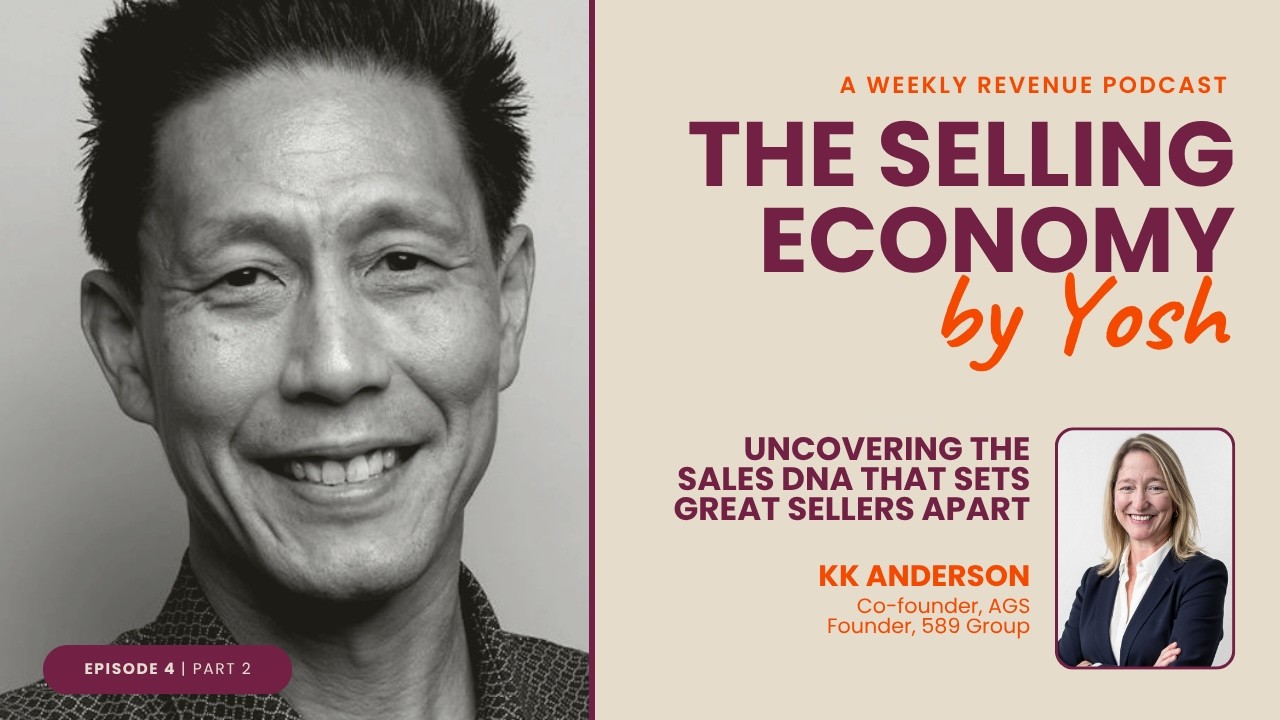
Uncovering the Sales DNA That Sets Great Sellers Apart (Part 2)
Part 2 with KK Anderson covers the beliefs that decide whether a rep uses the skills they were trained on, how to spot real drive in an interview, why a faster ramp removes the old filter for grit, and what CROs should screen for now. She closes with advice for new sellers and for reps ten or twenty years in.
Key takeaways
- Beliefs, not training, decide whether a rep actually uses the skills they already have.
- Self-limiting beliefs show up in an interview if you know what to ask for.
- A faster ramp removes the old filter for grit, so CROs now have to screen for drive directly.
- We are in a trust recession: outreach that is machine-perfect and all sounds the same taught buyers to discount it.
Chapters
- 00:36Welcome Back and Part 1 Recap
- 01:24The Beliefs That Determine Whether Skills Get Used
- 03:38Identifying Self-Limiting Beliefs
- 05:23Turning Seller Data Into AI-Powered Guidance
- 07:10Building Trust in a Trust Recession
- 09:50The Drive Great Sellers Need
- 14:16How Faster Ramp Changes Seller Development
- 16:40Why Human Judgment Still Matters
- 17:56What CROs Should Look for When Hiring
- 20:41How AI Changes the Role of Sales Managers
- 24:40What Sellers Should Get Good at Now
- 27:27KK’s Favorite Sales Moment
- 28:03Lessons From Sales Mentors
- 28:56Who KK Wants to See on the Podcast
- 29:37Where to Connect With KK
Read the full transcript
Introduction
0:01 Somewhere out there right now, a sales rep is walking into a meeting and sitting across from them is a buyer who already knows more than they do. That's no accident. AI has created the biggest shift in selling in 30 years. And millions of sellers and the leaders behind them are living it every single day. I'm Yosh and this is The Selling Economy, a show about the people in the middle of that shift and the stories of what's working now and the lessons that they've learned along the way. The Selling Economy is presented by AnyTeam, the team behind every rep.
Welcome Back and Part 1 Recap
0:36 Hey there, I'm Yosh and welcome back to the podcast. Last week, my guest said something I'm still thinking about. If you're joining us rather than there, go back and start with part one because this one builds right on it. Quick recap. KK Anderson is the co-founder and managing partner at Accelerant Growth Solutions and somebody who has evaluated 15,000 sellers. She made two points. First, that selling ability isn't one thing, it's three. And most of us have never pulled them apart. And second, that when AI has taken isn't the busy work, it's the craft, which to be honest isn't what I've been saying. So this week, the other two layers, there's one system nobody has touched and nobody's figured out how to teach. KK, good to have you back.
1:23 Well, it is so nice to be back, Yosh.
The Beliefs That Determine Whether Skills Get Used
1:24 Well, so let's dig in here. So topic number four right so let's talk about the layer that decides whether skills get used a rep they have lots of different skills we train and enable them uh and they have skills that they they don't you don't actually use you said it comes down to what they believe in elaborate on on that what is is belief or or what is it about believe so it is interesting and it's probably one of the most frustrating things for a sales leader or a sales enablement leader they spend so much money on training and getting these super in-depth sales processes and sales methodologies and all of the training and the role playing and then a rep doesn't do it right. And so really what that comes down to are these beliefs and there's a lot of self-limiting beliefs that are out there. So it's beliefs about money, right? Um about status, about being liked. And those self-limiting beliefs and those those beliefs that are holding back a salesperson, they're going to ruin way more deals than not following a process, right? And so, for example, like a rep's relationship with money, that's going to determine whether they can hold a price, whether they're going to negotiate against themselves before the buyer even asks for a concession, right? Whether they can say a big number out loud without their voice changing, right? I'm sure you've been in the room, Yosh, during some of these negotiations and you've probably even cringed a little like with who whatever sales rep you're working with, right? So, that's relationship with money is really, really, really a big one. And the research shows that how you personally buy, we call the supportive buy. How you personally buy in your own personal life when you're making a big purchase. If you are more likely to be the kind of person that when you're making a big purchase, you're going to think it over. You're going to do a lot of research.
3:12 You're going to talk to neighbors or friends, you're gonna kind of let it sit on the back shelf for six months. Like, if that's your style, and a lot of people have that or even if you have a scarcity mindset when it comes to money, then the research shows that pours over into how you sell. Interesting. Interesting. So, is this most common belief here that caps people, is this about confidence? Is this about conviction? Is it about preparedness? How do you teach that?
Identifying Self-Limiting Beliefs
3:38 The first step is knowing you have a problem, right? And so that's one of the reasons that whenever I work with clients and customers, the very first thing I do is a what I call a sales effectiveness and improvement analysis, which is where I'll do this assessment and I'll run them through 150 questions and find out like what are those underlying beliefs that they may not even know exist, right? Is their need for approval so high that they're likely not going to be able to get to the actual pain or the compelling reason why someone would want to buy something to really make and deliver that on that urgency. Are they able to sell to the C-suite like do they have that kind of stamina and maturity to be able to do that need to be like impacts all of that right their supported by cycle their ability to listen confidence like these are all things that you can't really find in an interview right you have to take the test so that you can find out what are the underlying challenges that are there now you asked how do you fix it and the first step is just looking at your own results and sitting with it and recognizing it and oftentimes and like you said earlier I've done damn near 15,000 times, if not over. A lot of times, somebody will look at their results and be like, "That's not true. I don't do that. That's not true. That's not a problem for me. I'm telling you that's not true." And then sure enough, 30 days later, they come back. They're like, "Wow, I can't even believe." It's almost like your reticular activating system in your brain is going and like you all of a sudden you see it. And so just knowing it allows you to see it and then it's easier to coach it. And then what about uh the perspective of like a system like how do you like systematize this? How do you put this into a system?
5:16 How do you build this into a layer of a system or a layer within an AI machine? What are your thoughts there?
Turning Seller Data Into AI-Powered Guidance
5:23 Well, when your data right and the data that we do for example, there's a lot lots of different ways that you can get data on a seller and their competencies, but when you can take all of the data, the one I do produces like 150 attributes per person, right? It's like a fingerprint. Every single seller is different. But if you can take that data and layer it into your AI platform, like at AnyTeam for example, then when it's giving you advice, it's like you're training the brain, right? When it's giving you advice, it can serve up, hey, you might be inclined to stop at this question, go deeper with these two, right? That kind of thing. like it can it can it can talk about how when it's time to discuss the magnitude or the return on investment on on whatever it is that you're trying to sell. It can serve up even just like when you're driving down the highway and it's like peaches for sale, peaches in a mile, a bucket for $5. I'm talking about.
6:15 I love when I see those signs because I I always want to stop. Love peaches and watermelon and and so even like that like you can you like technology is so incredible right now that it's it's almost like it's like your therapist in a box and just kind of serving up for you what you need when you need it. But I I guess when you think about all this is Joe Williams talked about in our podcast a few weeks ago the importance of being human and the importance of really being able to build trust. And it's kind of taking all the these things that a system might be able to do do for you and help and assist, but really kind of bring it back to to trust relationships and just being you. How do you take all of this diagnostic and all this data and really help sellers be more human? And maybe what you're saying it does because it's guiding them along the way, but have you seen that in like actuality or we still in the early innings of being able to kind of implement these type of kind of new type of of of systems?
Building Trust in a Trust Recession
7:10 Well, I think Joe is right. I did listen to that episode. It's fascinating. And from the buyer side right now is going down. We are 1,000% in a trust recession. And the mechanism is obvious like once you kind of think about it because every buyer's inbox is flooded with outreach, right? That's machine perfect. That all sounds the same. Everything is personalized looking while being totally hollow if that makes sense. Um, and the buyer has now learned that, like, for example, the poor em dash. When you see an em dash, you automatically assume it's AI. And that really sucks because I love a good em dash, right? And I left to right.
7:48 And I used em dashes all the time. And now I've had to like scrub all of my messages of em dashes, right? The baseline level of trust that a seller has. They're they're that deficit, that gap that they have to bridge is way wider than it ever has been, right? And so the trust, it is so important for that rep to share their humanness, have the empathy, to be able to be sincere, to be able to have the passion that they have for the product or service that they sell really come through. The one of the competencies we look at is called stays in the moment, which is all about listening. And I think I talked about this on our our part one of the podcast, but in that first sale, as we call it, where you're getting the customer or the prospect to articulate why they need to change, that's what it's all about.
8:32 Staying in the moment and it has nothing to do with what you're trying to sell. It is all about building trust. It's all about closing that gap. It's all about truly reaching out. Pretend like I always tell our clients, pretend like your email address is their email address. Pretend like you work at their company and today's your first day working with them. What can you do? What would you want to understand? What would be important to you? And the more value and insights you can bring, then the more trust you build and people buy from people they trust. I wanted to interject there. Joe also talked about having a badge and uh you just talked about that having an account uh with the customer.
9:08 Now these days everything is done online. I think the aspect of meeting your customer in person shaking their hand uh looking them in the eye and really spending quality time with them and their team is super important. But remember when Joe and I were doing some of these these large deals at Salesforce, the ultimate sign of trust was when both Joe and I had badges at ADP to go walk the hallways. So they treated us like we were part of them as employees. Uh and we treated them like they're part of us and we all had that that same objective of let's figure out how to make this successful because if we're all successful then ultimately uh our companies will be successful, right?
The Drive Great Sellers Need
9:50 So I wanted to just kind of kind of share that. Uh let's uh let's shift gears to to topic number five here. The thing nobody has learned to manufacture. So let's talk about this this third layer. The third layer is is about drive. Everyone says they hire for drive. How do you find drive in somebody? How do you then like build drive in somebody that maybe doesn't have the drive that other sellers have? And then ultimately how do you measure that? I think when you look across the spectrum, I've worked with thousands of sellers and I think everybody has a level of drive but some people are in overdrive and some people need to be in overdrive. Some people are in overdrive. I love it.
10:29 Yes. Well, and here's kind of the paradox is that drive is one of the most measurable of the three layers, but it's the least measurable and measured in practice really. And everyone claims to hire for it and almost no one actually screens for it. They may be screening for polish and enthusiasm and they might find out there's some overdrive there, right? And they might mistake those for drive, right? how you feel on your interview and on day 30 is very different than how you're going to feel on day 3000, right? And what we measure and it's kind of the thing underneath it. It's the desire. It's the unconditional commitment, the willingness to do things repeatedly that consistently without the pressure of someone holding their thumb down on you.
11:14 Like the self accountability, the degree to which they take personal responsibility for what they need to do rather than reaching for reasons that are out of their control, which there will be plenty of things out of their control which are going to get in their way of being able to sell. So, you really got to take think about all of you want to you want to ask questions related to unconditional commitment and ask scenario-based questions like when you were in a when you were in a situation where the cards were stacked against you product-wise and you still had to uh go out there and sell a product, what did you do? How did you do it? And see what they say. If you hear excuses, if you hear a lot of reasons why you weren't successful, a lot of that I mean that's going to tell you that their drive is not going to be there, right? And that's going to give you an indicator that their commitment is conditional upon everything else being perfect. So I think that's really what you're looking for. You're looking for stickiness.
12:06 I think how you describe drive is it brings the thought to my head is you can drive something from point A to C, but it's the steps in between here that really signal kind of the the completeness, the thoroughess, thinking through all the steps. So if you're in the driver's seat, not only do you have to drive kind of both internal and external stakeholders in a a B2B sale, but you also need to think about all the steps required to to get to the finish line. And I think that's where a lot of people miss is not thinking through all all the steps because every deal is a multi-step deal and there's always dependencies. There's always contingencies that come up. There's always timeline and and budget. So it's it's very complex and you have to constantly be thinking about like what are all these steps and these steps may change. So there might be branches that form where you have to go through different kind of paths to get to the finish line. So it's like driving a car with a blindfold on and one hand tied behind your back, right?
13:04 And um so not only is there a hyper complex road to navigate that's different with literally every company that you work with, one person could shut you down and you could be sunk and not even know it till you get to the end of the road. There's so many different things. Not to mention the fact that 70% of the time you're not going to win that deal. And so as the driver navigate, that's why sales is so hard and that's why you can make so much money in sales when you're good at it. Because if you can figure out how to keep yourself solid as the and your motivation and your consistency and you have the systems around the ability to be unconditional in the pursuit of what you're trying to achieve and like that just involves so much, right? And I don't think we've talked about this, but it is worth talking about and that's kind of the hot topic right now is that the buyers are so educated. Like back in the day when we all started in sales before the internet and now I'm dating myself. They would go to the salespeople for information. They'd go to the seller to get all of the details. Send me your one pager. Send me information on this product. Send me a proposal. Like they had no choice but to go get information from the salesperson. And now when they get to a salesperson, they know everything they need, right? It's just about that person. It's about that driver.
How Faster Ramp Changes Seller Development
14:16 Yeah, it totally it totally is. It puts so much added responsibility on a salesperson which goes into another aspect of something that I care deeply. I'm passionate about is ramp. One of the outcomes that I want to have with sellers I work with whether or not they use AnyTeam is ramp. Ramp should cut from months and months to days and weeks. And my question to you does shorter ramp make it harder or easier on sales people. They already have so much that they need to do including driving. I think the answer there unfortunately is harder. Don't you think?
14:48 And and this is this is one of the genuinely underappreciated costs, right, of the thing that we are otherwise right to celebrate. And this while the long ramp was painful and expensive, it did something valuable that nobody really had designed it to do. It was a filter. 6 months of grinding through hard, unglamorous work was a sorting. It's like a sorting hat, right? It sorts the people who had the drive from the people who did not. It tells you who's got it, who does not, who should be promoted, who should not. And it kind of was this revealing factor and you learned the tribal knowledge and you were in the trenches and you got all of this great information. Now if we collapse the ramp to two weeks and you have removed the test without replacing it, we've got a little bit of a gap there, right? So we can have a rep producing great output almost immediately with all of these AI tools, right? Because the machine is like carrying the craft as we as we've talked about. I just think it just changes how we upskill and how we get people ready, right? And I do believe it's going to involve a lot of practice and a lot of roleplay. And I know I know people hate role play.
15:52 Yeah. And is now becomes a big piece of this because now AI consumes you with more work. It consumes you with the ability to kind of do more with less. So if you're ramping if reps are ramping faster and you're now working on more accounts and you're working across more stakeholders both internal and external, and you're the driver, you have a million different things that you can tackle and do. So, it comes down to priorities and as a rep or seller, it's the judgment that you utilize to be able to say, "Okay, what is the most important thing that I need to do right now for this particular deal? What are the the two or three things that are important for me this week on these other three deals that I need to move the needle on?" It really comes back to at the end of the day, how do you apply judgment in this kind of AI heavy environment? And I'd love your thoughts on judgment. So, it's interesting thinking about the the tree analogy that I gave you in part one, which was think about the three layers of a strong
Why Human Judgment Still Matters
16:48 Seller, right? And as a reminder, the leaves are kind of the skills, the things a lot of those that we can use AI to help perfect. And then the trunk, right, is that sales DNA, those beliefs that we were talking about, the strength of sales mind and maturity to be able to do the right thing in the right moment for that prospect or that client. And then the roots is that will to sell, which is the grit factor. We talked about the drive, the commitment, all of and so when I think about judgment, like it's the trunk and it's the roots. And that's why AI is never going to replace a seller for a complex sale, right?
17:20 Because the AI may be able to educate and sell value and the AI may be able to tee you up in the perfect light to be able to have a great conversation, but if you don't have that DNA and the understanding of that of that process to be able to meet them right where they are when they are and have that judgment, then it's not going to land. So, I really hadn't kind of put it into this perspective until now. Thank you for kind of getting me thinking about it this way. But I think that's where the development and the training needs to go. It needs to go to the sales DNA, the mindset, and then to all of those how do we keep the driver healthy, will to sell stuff.
What CROs Should Look for When Hiring
17:56 Love it. Love it. There's there's so much to to dive into and uh this this world is moving really really fast. Let's move on to the last topic. Topic number six is what to become good at. Now, imagine CRO has a number. So, they built the plan for the year. uh in order to make the plan for for the year, they need to hire 10 to 15 reps in the next quarter so that they're fully ramped and able to be productive on the back half of the year, assuming kind of the old world of of kind of ramping reps and allocating quota, right? Given all of this, what advice would you give to a CRO if they were screening for hiring reps? It's not easy to hire reps.
18:31 And this is going to be painful to hear for a lot of CRO, but I would stop screening primarily for experience and craft and because those have been commoditized, right? And I would start screening for the two layers we just talked about. Do they have the strength of mind? Do they have the belief system? Do they have the sales DNA and the maturity to be able to have the proper human judgment through your sales process and to navigate your complex sales process? And do they have the will to sell? Do they have the unconditional commitment to do what it takes every single day consistently even when they don't want to? Even when there's a million reasons why they maybe think that they've got the odds or the cards stacked against them, but they still show up every day. If they've got that, then that is what you need, right?
19:14 Screening for that drive and those belief systems, that would be my call. Yeah. Yeah, I also like the aspect of intellectual curiosity is we're selling complex solutions and somebody who maybe doesn't have the domain knowledge that is jumping into a new area of selling. If they have the intellectual curiosity and the ability to to have that will and drive to go deep in that subject matter and ultimately the drive to help a customer be successful, then I think that they will be more successful than a rep that has years and years of domain experience in an area or years and years of selling experience. It comes down to their will to be curious and and ask those those right questions. Um find mentors, right? I heard on a podcast yesterday and I wish I could remember which one.
19:54 Um and if I did, I would give it credit, but the the speaker was saying how you can easily tell between a $100,000 a year rep and a $300,000 a year rep. And it's essentially in the interview if they come into the interview and they're basically performing the first sale on you, asking you questions, getting perspective, learning, like they're curious like they would be in a sale and it's not about them looking for a job, but it's about you and the challenges you're trying to solve and the business that you're building and your world and what's important to you. that is someone that has sales DNA because they're walking into a nerve-wracking situation where it's an interview where they could potentially get a job that they likely really want and instead they're making it all about the person who's doing the interviewing. Like I think that if someone can do that and and build trust in that way and build that relationship, I think that's a pretty good indicator.
How AI Changes the Role of Sales Managers
20:42 Yeah, that is absolutely right. Would love to learn more about about that topic. It's fascinating. I want to dig into a topic that relates to hiring. It's this notion of like if I'm going to hire 20 reps, I'm going to need to also hire a sales manager or I'm going to need to allocate these reps underneath the sales manager. So, traditionally, we've seen ratios of eight reps to one manager or 12 reps to one manager. Do you think this metric changes in this new world of AI and what I call the New Selling Economy where you could do more with less, but we're talking about coaching, we're talking about building trust, we're talking about things that may not be teachable by a system. What was your perspective here?
21:18 Really interesting because we all know that the sales manager is hands down the highest leverage point for a sales organization. They have the biggest impact over the sales team. I also always say it's the loneliest job in revenue because they can't necessarily go to their VP and say, "Hey, I don't know about this. This isn't working." Because the VP just wants to know if they're going to hit the number, right? And then they can't necessarily go and commiserate with their sellers because the sellers need to get confidence from them. And so they're on this island, right? And historically what managers were doing were, you know, deal inspection, forecast, policing, asking reps to, you know, update their pipeline every single day. And so like if that is like what management is, well then yes, automate that. Like that is a no-brainer. No one wants to sit in a freaking pipeline review meeting. Like they never have and they they don't want to, right? But here's kind of where that breaks and they need to be coaching the human layers. So in in a pipeline review instead of just saying hey did you get a hold of that decision maker or were you able to fill in more of your MEDDIC buckets in in Salesforce it's more of hey in that in that call in that intelligence the voice int whatever you know looking at the scripts looking at the deal you could have asked a question or you could have pulled on the string a little bit more about the fact that that machine being down was going to cause production to stop for a month. what could you have done there differently?
22:41 And then go into a a coaching situation, right? To get them to say, you know what, I probably could have said, well, how much is that going to? But I didn't because it's personal and it's rude and I didn't want to like upset them any more than they were and and I knew that they'd already done this research and and I was just feeling kind of rushed and so I just want, you know what I mean? So that's how the manager is going to change in my opinion. Yeah. I think whether or not the the ratios change uh over time, I think the true kind of test of time will be seeing how the adoption of AI kind of reaches the different layers of a sales organization from a rep to a manager to an organization all the way across the supporting teams. The one thing I think about a lot is we do want managers and we do want leaders coaching. And the core that enables one to coach is having memory. The ability for me to be able to coach my kids who play competitive basketball and to remember different scenarios or situation is my memory.
23:35 It's my memory of this game or that game or in some cases I just go watch the video recording and I coaching. But if you can imagine a manager with eight to 10 and all the different deals uh and scenarios that are being worked, it's a memory system and that's something that I'm excited to build and this is something that is really core to system that we are are building at AnyTeam, right? And when you have that memory and you have the frameworks and the systems that surround that, the idea is that the manager can focus on the person, not the pipeline. Right. Right. Right.
24:06 Um because as any sales manager can tell you, those pipeline review meetings are like broken records. They all sound the same and the next month they're doing it all over again. And that's because the pressure is on to hit their number. And so if you if you have a system underneath you that has the memory that automates the things that we don't need humans for, right? Then that will allow you to create an environment where your reps are building pipeline every day where your reps are closing deals every month and they're not stalling and sales managers can hit their number without heroics every month.
What Sellers Should Get Good at Now
24:40 Yeah. Fi final question is if you had to give advice, there's a spectrum of rep who's just jumping into sales. maybe they're in their mid-20s starting their first job in sales. So, what should they be good at? What should they be thinking about today? And then there's someone who's been selling for for 10 to 20 years. What do they need to be good at today? And what do they need to learn? So, for the new seller out there, I would say learn everything you can. Be a student of the game. Fall in love with your product and really think about what business problem does this solve. Study your ICP, your ideal customer profile, down to where they like to, what communities they're in, what clubs they belong to, what just know everything about them. What do they think about?
25:19 Because selling is not about you and it's not about necessarily even the product you're trying to sell. It's about them. And so that's what I would do. I would figure out what is a day in the life of that prospect of yours. And how do you communicate with them? And how do you take something complex and make it simple? get used to putting things into threes, buckets of three, right? And I would also say for someone just starting out is start early on your own personal brand because people buy from people they trust, right? Companies must have credibility, but people buy from people they trust. So post early, post often on LinkedIn, share your insights. You want to be out there and you want to get help to get yourself known. And building that network is going to be instrumental when you go to apply for your next sales roles as well because that VP of sales will say, "Hey, this guy's got 10,000 connections on LinkedIn and I have an overlap with 300 of them." Yeah. They've got a rolodex, right? So, I think build your network.
26:12 That's really important for you said the rep that's what 20 10 years in. Yeah. 10 to 20 years. Enterprise rep seasoned. Seasoned. What do they need to do? I think they need to I would probably say slow down a little bit and listen more and figure out. Usually at that point you're selling something that's more strategic and you're really solving big problems that are complex. And I I would also say to really honor and think about the sales process as you are going through your sales conversations because when you're working on big complex deals, you may have new players that come in at various moments of the sales process. you may be four or five meetings in and all of a sudden you've got a new VP coming in or you've got a someone from procurement who's sitting on the sidelines and when that happens have the the to back it up a little bit for them to slow down for them like hey so and so welcome here's what we've discussed here's the problems that are on the table here are the challenges we're trying to solve again nothing about your product or service but you have to always go back and start with the first sale for every new person in the room and when you do that you're building consensus this across all the other decision makers in the so I would be in control of the process because that's and that's really the most human thing that you can do.
KK’s Favorite Sales Moment
27:27 Fantastic advice KK for for both a new seller and and somebody who's been in the seat for for a while. I want to kind of finish off kind of our our multi-part our our two-part podcast with three questions. Three questions I ask every guest rapid fire. So question number one, what is your all-time favorite sales moment? I think the first time I sold a seven figure deal and I just was like, "What? I can't believe I just did that and I just made that much money." Like, that's got to be the feeling. That fun. That's an awesome memory. And that's why you do what you do. It's it's to help people kind of reach that that that aha moment. Question number two,
Lessons From Sales Mentors
28:03 Your favorite sales rep or manager you've worked with and what did they teach you? A couple things. I would say I I learned an incredible amount from Dave Kurlan who is the creator of the Objective Management Group assessment that I've that I've been repping for many years and I've spent many years on the top of that leaderboard out of 150 partners who that tool and I learned a lot from him around sales and some of the things that we've talked about today. And then I would say as far as a sales rep that I've worked with in my old consulting firm, there was a guy named Aedrod and he and I were very very close friends. We were like peanut butter and jelly in the sales process and I learned from him just to sit back and listen, right? And so both great. Dave is more of a mentor as Cedro is that we just did really well together.
Who KK Wants to See on the Podcast
28:56 Well, that's really cool. So the last question kind of relates to that question, but it's the nomination. Who's that one person that you'd like to see on this podcast and why? I know you know him, but I'm going to say Doug Landis. And he is the co-founder of Story Path. And I know you probably worked with him at Salesforce back in the day. Do you know Doug? Yeah, I do know Doug. Say hello, Doug. I think storytelling right now is so incredibly important. And so, he's got just some amazing best practices and tips and tricks around storytelling I think your audience would probably really enjoy in this age of AI. Well, uh, let's both reach out to Doug and I'd love to have Doug. It's a fun episode.
29:32 And I don't know if I can match his dress, though. You can match it with your Hawaiian shirt. Well, great. KK, this was was awesome.
Where to Connect With KK
29:39 Where should people go to find your work? Just, you know, you're well known. You have your own podcast, but you know, summarize where people could go find you. Find me on LinkedIn. I love connecting with people on LinkedIn. And it's Kristen K R I S T I N Keen. Kee ne Anderson is my LinkedIn. or I think you could probably type in KK Anderson and find me there, but it's like the in/christenke Anderson and would love to connect with anyone and everyone. Thanks for having me, Yosh. KK, thank you. And not just for everything you do, just for the entirety of the the sales industry, kind of the B2B kind of space, but also everything that you've done to help us in building this show. This has been been a fantastic podcast. Uh we're excited about what we call The Selling Economy.
30:23 So, until the next one. All right. Thanks, Yosh. Thank you. That's the show. If this one sharpened how you think about selling, send it to one person on your team who should hear it. Follow The Selling Economy wherever you get your podcast and subscribe on YouTube so you never miss a conversation. To learn more about AnyTeam, visit anyteam.com. New episodes every Wednesday. I'm Yosh. So long. Thanks for listening.