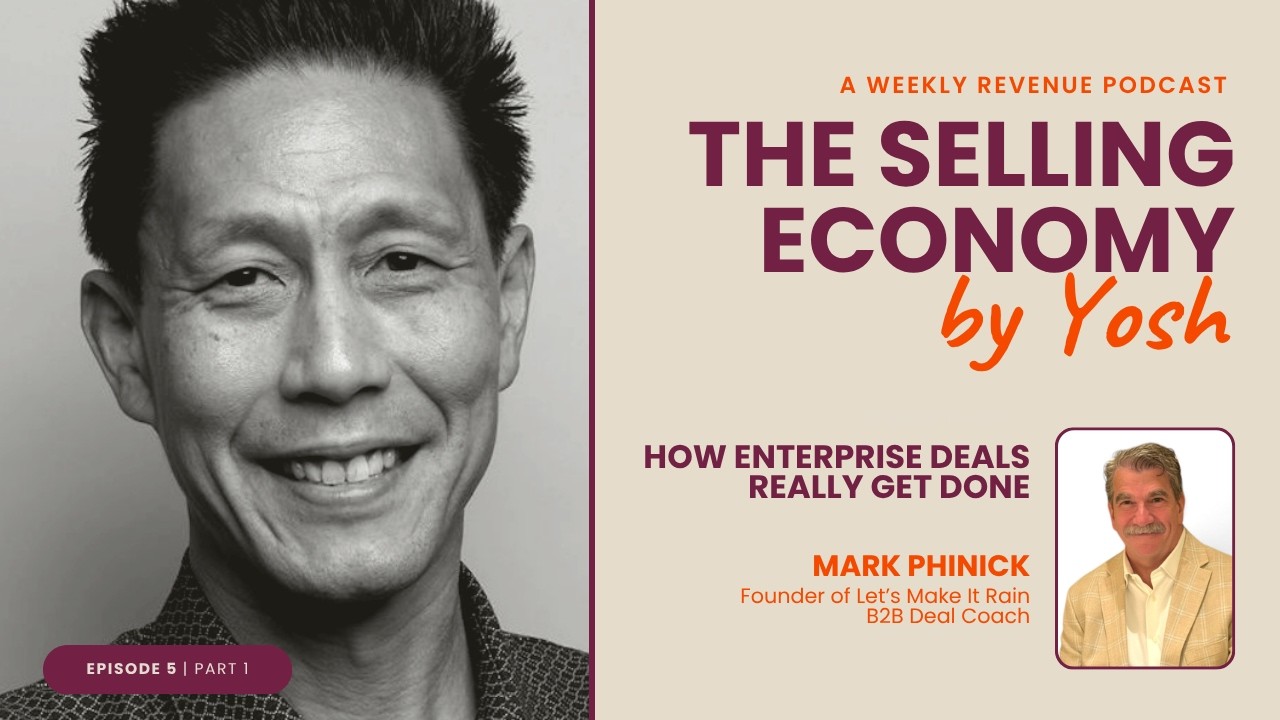
How Enterprise Deals Really Get Done (Part 1)
Mark Phinick has spent nearly 30 years in enterprise sales, through two IPOs and more than a decade in endpoint security. He and Yosh take apart why promising deals stall between interest and action, the four conditions he looks for before calling an opportunity real, and why the person who finds your solution is almost never the one who funds it.
Key takeaways
- Deals stall between interest and action, not at the pitch — once stakeholders, risk, budget and approvals arrive, enthusiasm stops being a signal.
- Four conditions make an opportunity real: the cost of inaction outweighs the cost of change, there is a business case worth funding, an executive owns the decision, and stakeholders agree on the path.
- The person who finds you rarely funds you. Equip your champion with the business case, language and evidence to sell it when you are not in the room.
- A technical integration conversation at Cast Iron turned into $320M in potential annual savings once it was reframed around what each stakeholder actually owned.
Chapters
- 00:00Introduction
- 00:36Meet Mark Phinick
- 01:12Why Complex B2B Deals Stall
- 03:05Deal Coaching vs. Sales Training
- 05:24Coaching Live Opportunities
- 07:08Decision Ownership and the Four Conditions of a Decision
- 09:12How to Know When a Deal Is Real
- 11:39Turning Buyer Interest Into a Real Deal
- 12:05Helping Champions Sell Internally
- 15:24Connecting Solutions to Business Outcomes
- 16:51The Cast Iron Enterprise Deal Story
- 20:22Turning a Technical Sale Into $320M in Potential Savings
- 21:12Why Different Stakeholders Value Different Outcomes
- 21:49Relationships and the Human Side of Enterprise Sales
Read the full transcript
Introduction
0:01 Somewhere out there right now, a sales rep is walking into a meeting and sitting across from them is a buyer who already knows more than they do. That's no accident. AI has created the biggest shift in selling in 30 years. And millions of sellers and the leaders behind them are living it every single day. I'm Yosh and this is the Selling Economy, a show about the people in the middle of that shift and the stories of what's working now and the lessons that they've learned along the way. The Selling Economy is presented by AnyTeam, the team behind every rep.
Meet Mark Phinick
0:36 Hey there, I'm Yosh and welcome to the Selling Economy, the show about how deals really get done. My guest today is Mark Phinick. Nearly 30 years in enterprise sales, two IPOs, more than a decade in endpoint security, and now he coaches founders, reps, and sales leaders on the hardest thing that most people miss. internal selling, stakeholder alignment, and getting a real decision made when you're not in the room. He wrote the book on it, when deals go quiet. Mark and I go back to the Cast Iron and Salesforce days. And he's one person that I'm really excited to talk to today. Mark, let's get into it. Welcome to the show. Thank you, Yosh. I'm delighted to be here.
Why Complex B2B Deals Stall
1:12 Hey, Mark, what are you seeing in the industry and what led you to launch your deal coaching practice and write your book? So, you and I have been doing B2B deals for a long time, and the one thing I think you'll agree with is they get complicated real quickly. Regardless of company size, industry, whether you're selling AI today, cyber security, commercial services, marketing programs, deals can slow down when multiple people, priorities, risks, approvals stand in the way between interest and action. So, it's a daunting task. And unfortunately, we've seen founders run out of runway before they can turn a product into a company. We've seen sales leaders miss their quarterly number when deals get pushed within weeks of when the CRM says that they're going to
2:00 2 minutes close. And my own personal worst pain is watching reps left to figure things out for themselves. Sometimes afraid that their role will be questioned if they're really honest about a deal or a customer issue. So that that's not because their management isn't there. It's not because they lack skills. The managers today, they're running the forecast. They're managing the team. They're carrying a number. Um there's a lot of pressure on them. So they're sometimes increasing pressure to close. And that pressure can lead to discounts that hurt margin potentially even reducing future revenue. So what I saw Jeff was three years ago I was running global sales for a cyber security product with an HCL that I had done the same role for five years at IBM and I saw a need for an
2:48 impartial person, somebody outside the reporting chain who could challenge the assumptions, find blind spots, pressure test what was real, help the rep, equip the champion to sell when the rep's not in the room, and plan the next move. So
Deal Coaching vs. Sales Training
3:05 Mark, I've seen all these. I've seen this in the early stage startups that I've worked in. I I've seen it at levels of of operating in a public company. And oftentimes when these situations happen when you report earnings, there's definitely an impact to to a company's stock price. And it's a very common problem. The question I have though based on that is like how is what you're doing and how is deal coaching different from sales training or different than what a sales manager already does? Yeah. So it's been my experience. So I had the good fortune of attending lots of sales training throughout my career from Sandler and from Caris and just you know the best in the industry IBM that kind of all went aside with COVID and
3:49 there were we we left a bunch of sales people now entering the workforce without any of those skills but they still had their quotas. So what I did find is even now that it's now that sales training is is coming back it's typically done in theory abstracted from individual deals and it's also typically conducted at sales meetings and not to be too snarky but you know kind of sandwiched between when the AP team hit their target and how they did it and all the great things that are irrelevant to my deals and happy hour right it's just a thing that gets on the agenda there's product presentations and and different departments have to talk, but training is going to teach the basics. It's generic. And if you look around the room during these classes, what you'll
4:36 typically see is the top reps checking their emails with the deals that they're working. That's what they want to talk about with sales leaders, with the executives. So, what I promised to do when I launched this practice was to help reps figure out what to do next in the moment on their live opportunities. I'm not replacing a sales manager. They're managing the team. They're running the forecast. They're carrying the number and they're dealing with everything else that comes with the job. That impartial person who gets inside two or three opportunities that really matter. I help the reps challenge the assumptions. We look for blind spots and ultimately help them figure out what's the next move. It's very, very specific to the deal that's in front of us now for near-term revenue. I love that because I've been a part of these these
Coaching Live Opportunities
5:27 kickoffs, these off sites, these QBRs, and you always see reps kind of stepping out of the room to do customer calls. And it's usually to focus on a deal because at the end of the day, deals are generally done on a customer's timeline on partially kind of their terms in terms of when they're available. So, these are things that that you can't control. But what you can control, which I think is what you're doing, is how do you kind of coach reps in selling founders? So maybe can you be a little bit more detailed around how do you actually do that? Sure. So the first thing that we'll do is huddle around two or three opportunities that can make a difference this quarter. I've built a business tied to my clients success modeled spoton after Salesforce, right? We learned how
6:12 to do this with devoting ourselves to customer success knowing they may not renew. That was the nature of SAS, especially now that a lot of products are doing month-to-month. If you're not helping an organization increase revenue, reduce cost, lower risk, you may not get a renewal. So, I built this business focusing on the deals that are relevant to near-term revenue. What we'll do is we'll take a look at those deals. We'll pressure test the customer's current situation. What's their approach? What friction are they dealing with? How is it impacting people emotionally? How is it impacting revenue? Is there leakage? How expensive is it? Is it costing too much? Is there is there are there risk to it? And and what changes if they fixed it quickly?
6:56 And who cares about fixing it sooner? We'll talk about that in a little bit. But what has to happen for decision owners to feel comfortable deciding to move forward?
Decision Ownership and the Four Conditions of a Decision
7:08 And that's an important topic in your book, decision ownership, right? So what what is is decision ownership? Yeah. So everybody in every organization has enough priorities and typically when somebody wants to buy something new, they either have to wait for a budget cycle to free up or convince the business to reallocate budget from currently funded projects. That means change and change elicits fear, uncertainty, doubt. So that staying put is always the safest choice. Well, our role is to create a compelling reason to act, right? So sellers need to help manage that risk that change so that executives will feel comfortable owning and defending that decision. I in the book I write about four conditions of a decision. Right? This isn't rocket science but it comes from doing this some over some time. The first condition is that the cost of inaction is more
8:04 expensive than change. the current environment is just too expensive, too painful emotionally, operationally, financially. Secondly, they the client, the the future customer, knowing me, I don't use the term prospect. I think that's degrading and I I look at everybody optimistically that they're all a future customer. So, I think of future customers being able to articulate the business case that's worth funding because we're not going to be in the room when they go pitch it to their executives. Third, there has to be an executive who's been identified who will own the decision, the change, the budget, the approval process. And then lastly, there has to be stakeholder alignment with a go live plan with actions owners dates so that people know we're not just buying more toys, right?
8:52 Selling cyber, you learn, boy, finance just looks at all these toys that it has bought and we're still getting hacked. 9 minutes There has to be a business reason to act on this. So if those four conditions aren't present, we're we may have interest but we won't have a decision and without a decision there's no deal.
How to Know When a Deal Is Real
9:12 I think that is so important because these deals in the enterprise because often times they're mission critical systems take a long time involve a lot of people. you're gathering a lot of input from people that for this decision to move and to make change, but there's oftentimes as many people as there are four against it because people want to just kind of stay in the comfortable lane versus versus move into the new lane. So, I love this very simple kind of four-step formula for looking at decision ownership. It's really easy to be optimistic about a deal, right? We all get kind of happy ears like, "Oh, this deal is this deal is going to close. This deal is hot. I got a champion on the line." But how do you determine like how do you really
9:52 determine when a deal is real? That's hard. I used to love doing forecast calls and I would speak with my reps and they'd say, "Oh, we had a great meeting." Really? Why? They love us. Why? And if it doesn't resolve in math, we are going to help them increase productivity, streamline this process, help them increase revenue, reduce cost, lower risk. It has to resolve in in in the business outcomes that they're that they're working on. So I tend to focus on whether the customer, the future customer is actually moving towards being able to make a decision that they can defend internally. From the first time I meet with somebody, I'm already thinking, well, where are they in their decision process? If they if they start
10:37 our meeting by telling me how bad things are, I know they're already thinking about solving this. They can love the product and still not be ready to make a decision to move forward. So I tend to pressure test and pressure is a very heavy term. One of the things that I did when I launched this business was said I never want to fire anybody. I never want to yell anybody at anybody again. I don't want to hold cadence calls. There's no pressure involved in coaching. It may be sometimes a therapist call and I'm helping somebody. Um uh and I and I and I speak directly but there's there's no pressure that we typically associate with sales some sales managers you know where it's landing. So, I tend to pressure test where what we know versus what we're
11:20 assuming. And I look for those blind spots. Are they building internal conviction or are we mistaking interest for intent? If they're not moving towards a defensible decision, again, we may have a we may have interest. We could build a huge fan club, but we may not have what we need to do a deal at that as as a CMO, former CMO, my job was to make sure that there's a lot of
Turning Buyer Interest Into a Real Deal
11:44 people that have interest and and then the hardest part of the process was then converting those people that had interest into real deals. And then ultimately the even harder part was then converting them into customers, right? So you talk about kind of the people that find you are rarely the people that fund you. Isn't the answer just kind of making a call higher up up the food chain? What's your your thoughts on that?
Helping Champions Sell Internally
12:06 Maybe if you're a Microsoft, an IBM, an Oracle, a Salesforce, a Crowd Strike, you name it. If you're a big big big company, if you're Sam Alman, if you're Daario, if you're Elon, yeah, you can call a CEO. I can't. You probably can't. I've been fortunate to be part of over hund00 million worth of purchases at General Motors over my career. I've never met the CEO. I promise you, I'm never going to. I'm sure they're very nice people, but we associate in different circles. So whether you're selling commercial roofing or AI or cyber security, you're most always selling to someone who has to sell it internally. My whole career, I used to love working with, and I still do, enterprise architects. They have no budget. They have no authority, but boy, they know where everything is. They know how many agents they really want to do.
12:56 They know the status of AI within the organization. Do they trust it? there there's just so many people that we have to deal with that we have to go look for people that like our solution and help them sell. That's become the role of a sales professional now. Not only to, you know, repeat what marketing has created and be able to speak eloquently and take people out for dinners and stuff, but we have to help equip the champion sell internally when we're not in the room. So in reality, even if you started with an executive, that's great, but they still have to sell it to their team. And because they don't buy your solution as much as you sell it, they do need some help. Equipping the champions is
13:39 absolutely key. You made just an excellent point of marketing. And the reality is people are going to websites, people are using AI to find products. That's not where they need salespeople. where they need sales professionals is to help them buy the product the way other clients have bought it. It's a really important question. If you're a procurement manager, how have or if you're not a procurement manager, but you're going to be the user of the product. Tell me how I should get this purchased internally. You're selling an AI platform. We love what you're doing, but man, we've got co-pilot everywhere and we're bringing in all these McKenzie and Bane and BCG to give us guidance on all this stuff and I got a business to run and my competition is running faster than me.
14:26 How do I get this done? And that's exactly where I live. So that means collaborating on an irresistible and forwardable proposal. Not 40 pages, but maybe two to three pages that resonate with the people involved emotionally, operationally, financially, and it helps the champion communicate that everything they need in a concise and conumable investment request. If you think about it, Jeeoff, we used to always joke executives need big animal pictures. It's not cuz they're not smart. We know that's not the case. It's just there's so many things going on. Think of our world's closest in the kitchen at the companies we've worked with. We know the heat that's in there. And so you have to be able to speak at their level. You have to speak in their language.
15:14 Sometimes that language is math. Increase revenue, lower risk, lower cost. When you get to finance, that's what you're dealing with. But that's what we're doing is we're helping people who like us buy us.
Connecting Solutions to Business Outcomes
15:24 Pain and outcome. That's what you're talking about there. It's so important. It's like if you think about the early days of Salesforce and Cast Iron, right? What was Salesforce? Salesforce was a Salesforce automation tool. What was Cast Iron? Castiron was an integration appliance. Why were the two systems needed? It wasn't for just integration. It was to connect workflow that would drive business outcomes and productivity between the two systems. Whether it was keeping data in sync, whether it was allowing for an order to be fulfilled from Salesforce and then get processed into the procurement system or the invoicing system, that was about outcomes. Otherwise these systems would be sitting silos and sales rep wouldn't be able to to do anything except for opportunity management and wouldn't get
16:06 deep into the organization. So I think kind of pain and outcome I think is important. I think when I look at my kind of experience kind of working in the enterprise even with security solutions and even developer tools right you can say that oh hey there's people that can kind of get started really quickly and they can go ingest and add data into the system but the the buyer is looking for not speeds and feeds how are you going to help me transform my business so I love what you said there Mark and let's talk about kind of connecting right connecting with your clients kind of solution with with outcomes. How do you do that? Tell me some stories that you've been involved in where deals slipped or you applied
16:46 that to a deal and you kind of overcame kind of these these challenges. Sure. So, you you mentioned Cast Iron.
The Cast Iron Enterprise Deal Story
16:54 I'll give you a Cast Iron story, but I have fun stories and that's by the way what your customers are looking for is they're looking for executive stories that because that's what people remember. So, I'll share with you a story. You may know this, you may not, but I was with Cast Iron and what what Cast Iron systems was a still is. It's an integration appliance that you would rack rack mounted completely integrated appliance that accelerated the time to integration rather significantly over softwarebased integrations which required users to go requisition servers by databases. Lots of stuff that had to get done before integration could start. So, we were selling this integration or this fully integrated appliance that promised integration in days. I was I was uh speaking with a future client on
17:40 telephone trying to do a discovery call, but they wanted to share nothing. But I also knew that it was an account I wanted to meet with. So, they wanted me to fly in. I flew in for a demonstration and after the demo, asked them, "What do y'all think?" And they're like, "Oh my god, this is exactly what we want. This is like this is the bomb. This is it. 18 minutes this is exactly what we want. One problem. Your competition is upstairs negotiating a $10 million deal with their product. I'm like, wait a second. I just flew out here for this. They're like, I know. Just, you know, we got to have a contingency plan, which is also something that I learned long ago. Most customers always have to have a plan B
18:20 in case that $10 million deal doesn't get negotiated properly. Something goes south. Everybody's always needing to have a plan B in their pocket. So, I was fine being a contingency plan and but I was I was kind of rattled by this $10 million number and I'll tell you why. So, we were selling an appliance that at tops a deal might max out at a million dollars and we had not even done that size deal yet. I think the largest deals we were doing were 3004 300 maybe $400,000. So, I'm thinking maybe this could max out at a million dollar. So, I had to ask why are you all even doing this? let's just and I it wasn't like a discovery call on the phone where they
18:59 could say no, we don't want to answer that. I was in the room with them. I had already won their hearts and minds by showing this demo. We were on the same side of the table. So, they answered and the answer was, you kind of alluded to this. They had a lot of systems. Well, specifically, they had 16 different ERP systems through acquisitions and growth and they needed to integrate them. I asked why. I mean, that's such a powerful question. And they explained that because they have all these different systems in all these different geographies. What they were seeing were situations where vendors were offering different vends in different geographies and they believed that integrating all these ERP systems they could help rationalize those discounts and reduce their annual IT spend by about two. Well, next
19:49 question is what's your annual IT spend was about $16 billion. So at that point, I mean, aha moment, the light bulb goes off. We're we're moving from selling integration in days to helping this customer pursue a $320 million potential annual savings. So I asked, when does the competitor when are they promising these savings? When do they expect to be able to complete this project? And I was delighted to hear that it was going to take over a year. Now remember, we were promising integration days. So that's right. got up the courage and asked who in this building would be interested in seeing that $320 million
Turning a Technical Sale Into $320M in Potential Savings
20:29 start this quarter and that changed the deal and it opened the door for us to do a pilot. It was really fun because what we heard from our champions is that our competitors had sent all their suits in and they were proddding around in our appliance and I said just let them know that if they they touch a box and open it up that breaches the warranty and you guys are going to be on the hook for that. So they nobody nobody did that. We won our deal. And when I went to go pick up our order, this is when you would go on site. This is gosh, I miss these days. Co just killed us with this. But you know, I I got on a plane. I flew to meet with the customer. I introduced myself to the chief procurement officer and they interrupted. I said, "I know
21:08 you. You're the guy who saved me $9 million." So wow, that was another aha moment. Yosh. So
Why Different Stakeholders Value Different Outcomes
21:15 what I recognized was that different stakeholders cared about different KPIs. They cared about different outcomes. It who we were selling to, helping them buy, they cared about the $320 million a year in annual savings. What procurement cared about was saving $9 million out of 10 on this deal. Everybody gets their bonuses. And so that's why you have to connect your solution to monetized outcomes that each stakeholder owns. It's a fun story. And I'm uh delighted to say that I still stay in contact with the chief procurement officer.
Relationships and the Human Side of Enterprise Sales
21:49 Well, that is going and picking up that order. Most sellers at least over the last 10 years since the the advent of e signature, everything is done now through the internet. But those days were fun. I tell a story and this was a very small deal, but this is a startup I worked at. After Salesforce, it was Zora. I called the airport deal. It's last day of the quarter. I had to close a deal uh in order to get us over the finish line. So the CEO says, "I can't sign the order form because I'm flying on a plane." I said, "Hey, Carnett, let me go pick you up at your house in San Francisco. I'll take you to the airport if you sign the order form." Absolutely.
22:22 We got the order form done. And uh I do miss those days. Today, everything is done through through e signature and docyign. And the fact that you have that relationship with that procurement officer many many years later goes to to the point of really how you actually help that organization, how you help that that individual and then how you built this this long-term relationship with the stakeholder that now you can probably call a friend. Well, that's really cool to do. So, and it's funny because you mentioned the car ride. So, I've had a couple of those in my career where I remember very very vividly I was working with an organization and their CIO was based in the UK and we were finishing up a meeting and it was he was pressed for time and he said, "I need to go. I got to catch a flight." I said, "Well, okay. I'll drive you to the
23:04 airport." He goes, "No, no, no. I got to stop at home and and pick up my stuff." I said, "Look, I've got nothing to do this evening more important than this. I'll drive you." We got in the car. It was like the best I don't know what it was. An hour, two hours of customer time you could ever imagine. We talked about fishing. We talked about fish and chips in the UK. We talked about sports. We talked about lots of stuff. But it gave me an opportunity to build a relationship with somebody who went back did our deal much faster than I think he had done without it. So, thanks for that memory. That's great. Yeah. Yeah. Phenomenal. That's the show. If this one sharpened how you think about selling, send it to one person on your team who should hear it.
23:46 Follow the Selling Economy wherever you get your podcast and subscribe on YouTube so you never miss a conversation. To learn more about Any Team, visit AnyTeam.com. New episodes every Wednesday. I'm Yosh. So long. Thanks for listening.