/ 101
Get help
AnyTeam 101 · Start here

The team behind every rep.

Built for the New Selling Economy. AnyTeam carries the operational and cognitive load of selling — the research, prep, follow-up, and constant context-switching — holds memory and gets smarter by the day, and gets you back to selling, the part that's uniquely human.

01

A team that's always working

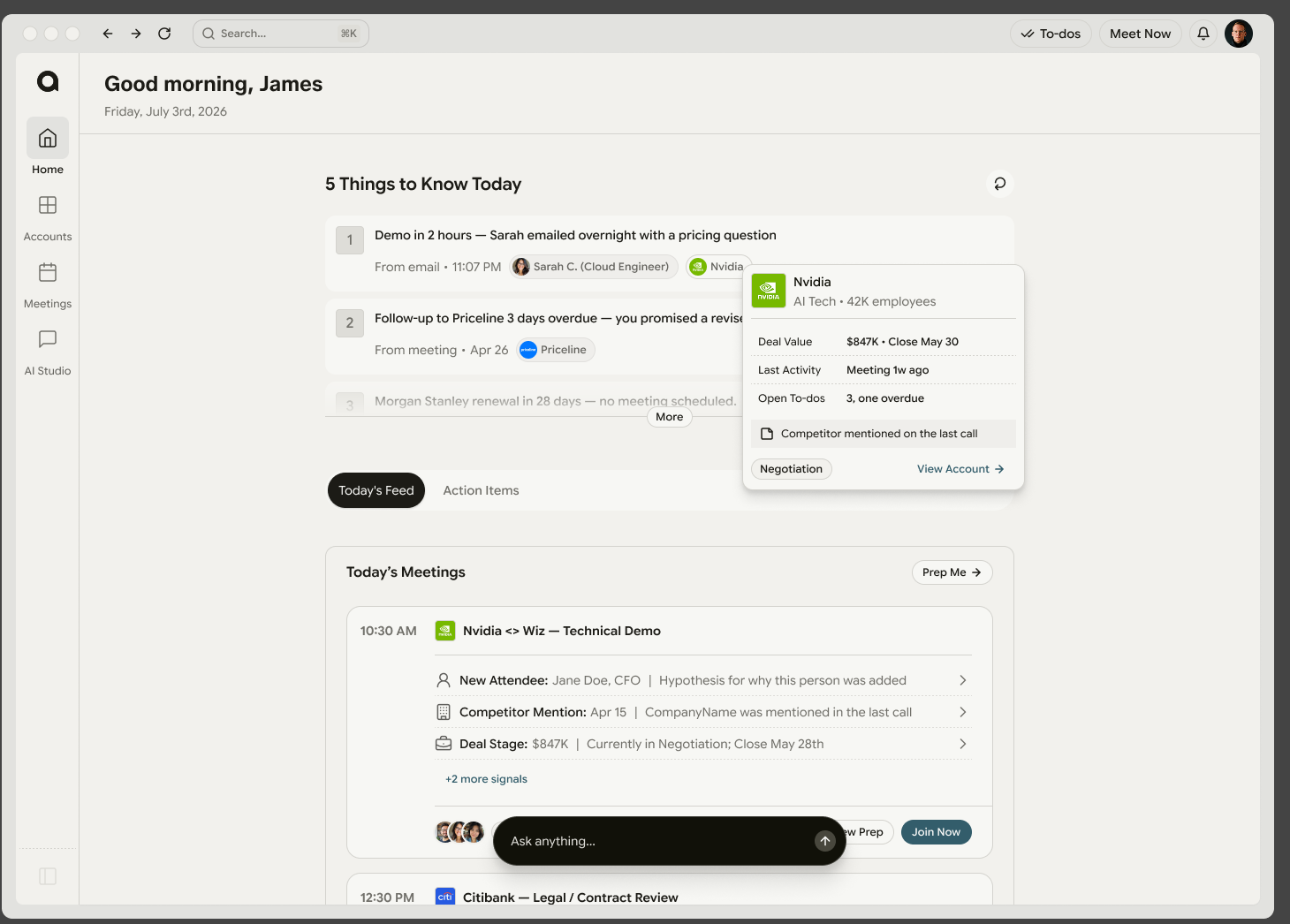
Knows what you need to do every day of the week and continuously prioritizes the "must-do" things — from your calendar, email, Slack, CRM, meetings, and more.

02

A team that's in every meeting

Provides live answers and real-time guidance — with contextual memory from previous conversations — while your meetings are happening.

03

A team that gets smarter by the day

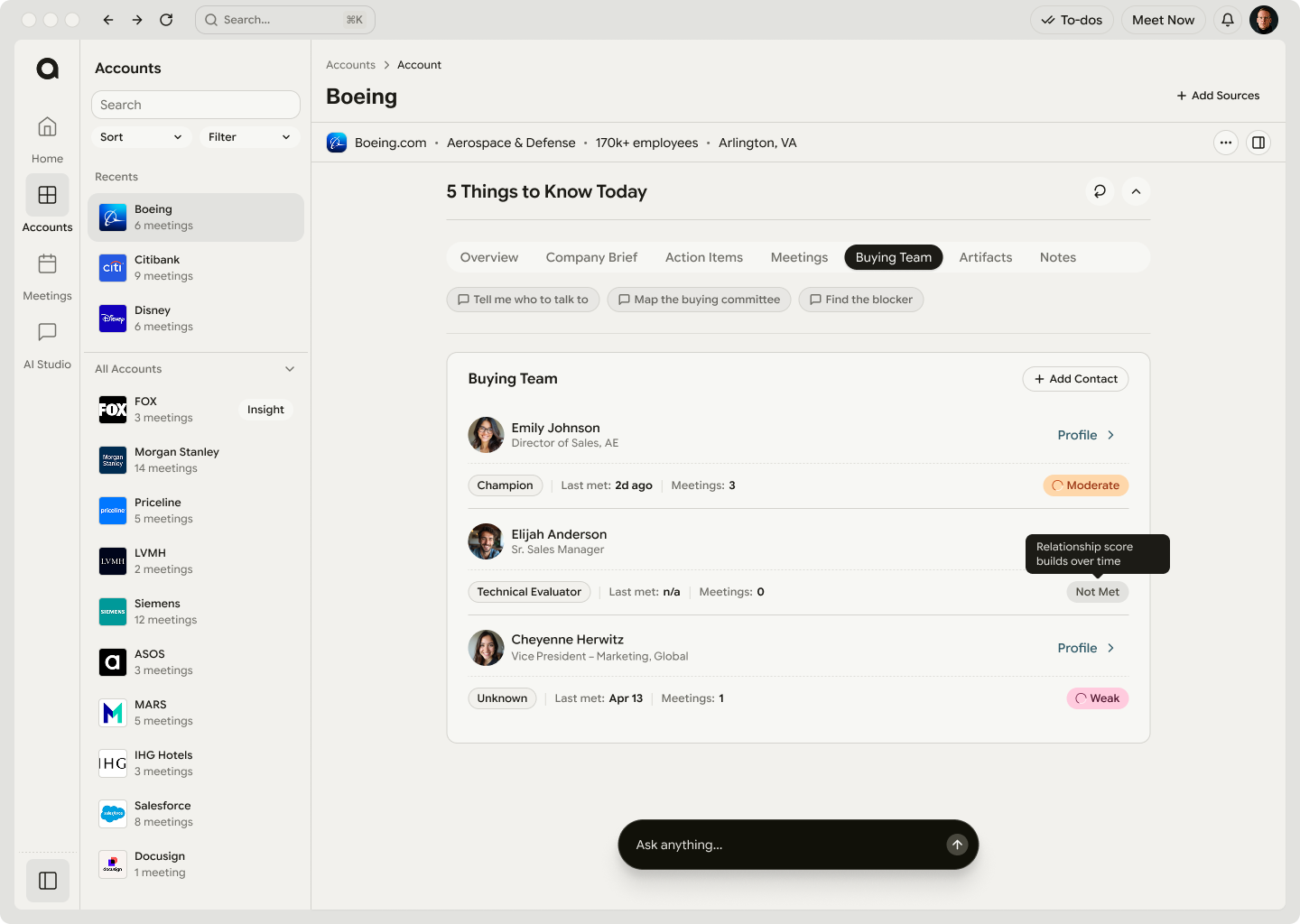
Remembers your to-dos, your writing style and follow-up cadence, your competition and deals — and runs agents continuously while you sleep.

What's inside

Jump anywhere
01

Getting started

~5 minutes, once

From install to your first call — a few minutes, once. Nothing's locked in; you can change any of it later in Settings.

1

Download & install

Grab the AnyTeam app and drag it into your Applications folder (or Windows equivalent), then open it.

macOS · .dmgWindows · .exe
2

Log in

Sign in with your work email. Everything stays scoped to your workspace.

Work email
3

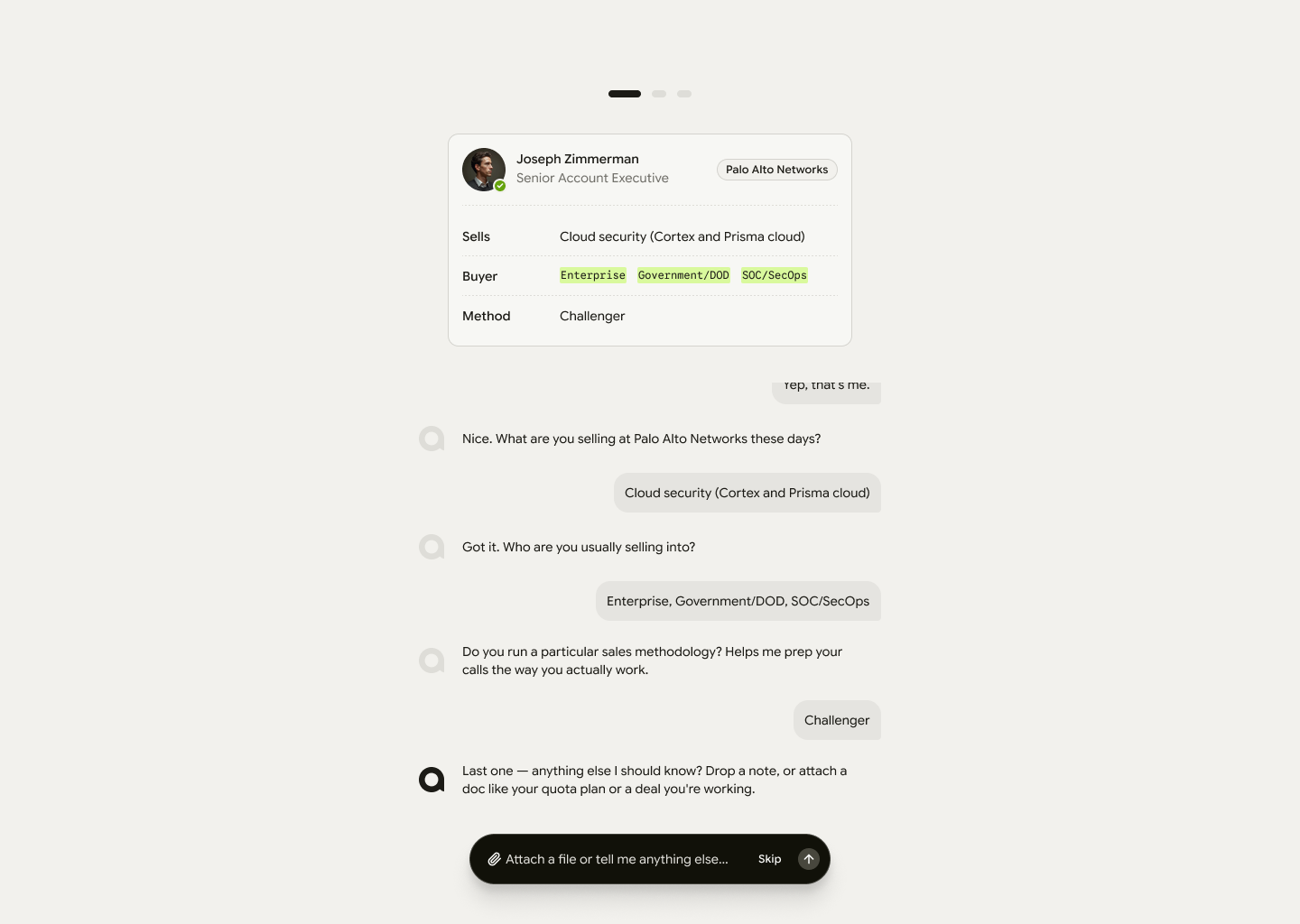
Build your profile

Tell AnyTeam who you are, what you sell, and who you sell to — your role, product, market, and how you run a deal. You can always change this later.

Profile builder
4

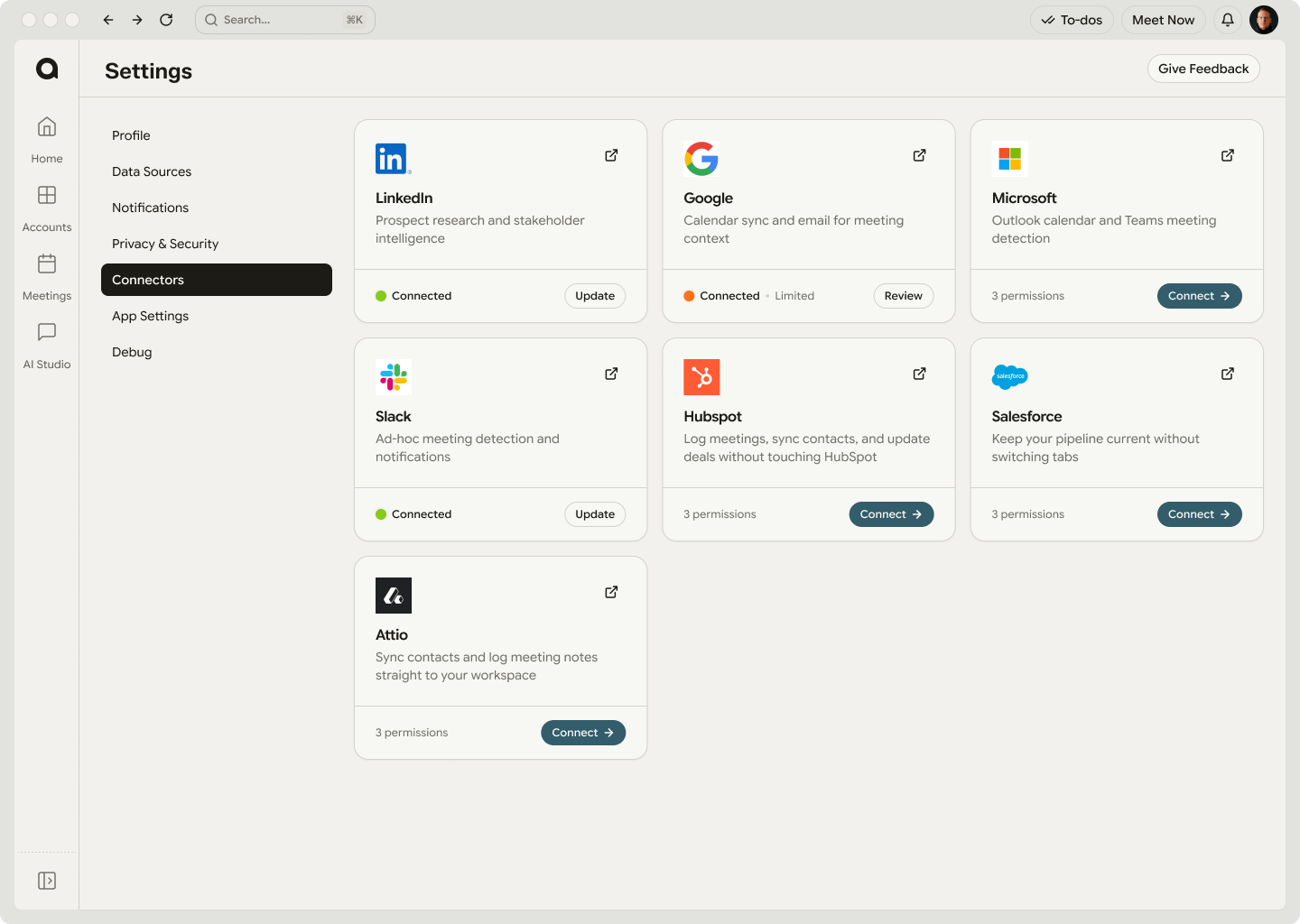
Connect your tools

The more you connect, the more AnyTeam knows — and the more it can do for you. You pick what to share.

In tightly managed organizations, an admin may need to approve AnyTeam or grant consent before some tools finish connecting.

5

Let AnyTeam set up your workspace

AnyTeam builds your workspace from what you connected — your real meetings, accounts, and signals. You land on a live Home with no empty states. Start exploring.

AnyTeam setting up your workspace
6

Grant meeting permissions

To bring AnyTeam into your meetings, you'll grant a few system permissions when prompted — this is what lets Pilot join the call.

Mac
  • Microphone
  • Screen recording — for meeting capture
  • Accessibility — for meeting detection
Windows
  • Microphone — enable in Windows privacy settings
7

Change anything, anytime

Edit your details later in Settings — your Profile and Connectors. Add tools, upload docs, tweak how you sell.

Your first move

Bring AnyTeam into your next meeting

The fastest way to see it work — turn on Pilot for live transcription and real-time guidance while you're on the call.

Meeting Pilot guide

Nothing outbound ever sends without your approval — no email, CRM write, or Slack post goes out until you say so. Not ready to connect tools yet? Explore in Demo Mode and link them later.

02

Meeting Pilot cheat sheet

In-call moves

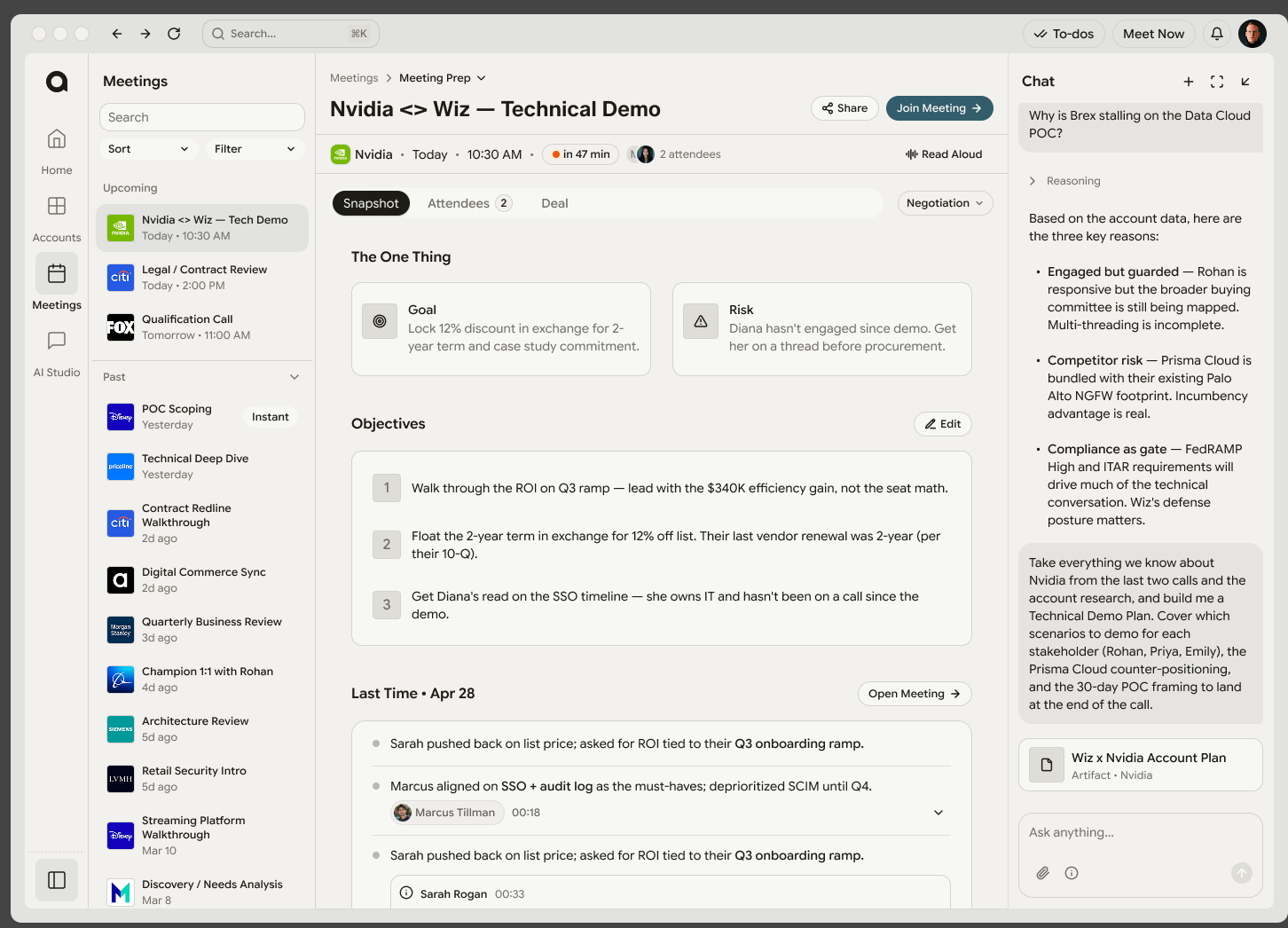
Bring AnyTeam into a call and it transcribes live and surfaces help the moment it's useful — answers, objection recovery, competitor intel, and more — right beside Zoom or Google Meet. And it compounds: the more meetings you run with Pilot, the more it learns your deals, competitors, and style — and the sharper its guidance gets.

1

Starting a call

Meet Now · the hotkey · from a meeting
Start a Meeting Pilot
AnyTeam app top bar — the Meet Now button sits top-right, between To-dos and the notifications bell
Click Meet Now in the top-right — it's there on every screen.
  • ⌥ M Or use the hotkey — Option+M on Mac, Alt+M on Windows.
  • Or join straight from Home or any Meeting Prep.
  • Pilot appears as a floating bar next to Zoom or Google Meet the second the call connects.
How to join a meeting
The Pilot Bar — collapsed & expanded
The AnyTeam Pilot Bar, shown collapsed (icons only) and expanded (with tab labels)

The Pilot Bar floats above Zoom or Meet — drag it anywhere. Tap a tab to open its panel as a separate movable window. Pause captures a break in the recording; Stop ends the call and kicks off the summary.

2

The five panels

Each tab opens its own floating window
AnyTeam Pilot Chat panel
Chat

Ask about anyone or anything on the call — attendees, the deal, competitors. Grounded in the transcript so far, your CRM, and your inbox.

AnyTeam Pilot Live Transcript panel
Transcript

Live captions with speaker labels and elapsed timestamps. Auto-scrolls until you scroll up. Search highlights matches. Every guidance card cites the exact line it fired from.

AnyTeam Pilot Overview panel
Overview

The attendee-and-account glance: who's on the call and their roles, last-meeting recap, and any updates since your Meeting Prep was generated.

AnyTeam Pilot Notes panel
Notes

Your private scratchpad — free-form, markdown, indented lists, resizable. Notes stay yours; they never appear in shared summaries.

3

Guidance — the star

Proactive intelligence, no prompt needed

The Guidance panel watches the transcript and surfaces context the second it's useful — no prompt required. Cards appear when someone asks a hard question, drops a competitor's name, raises an objection, or you drift off track.

Every card is pull, never push — nothing steals focus, nothing auto-speaks. Dismiss what you don't need, unknown topics get flagged rather than made up, and objectives tick off as you cover them.

The Guidance panel — a scrolling column showing a time reminder, question detection, meeting objectives, and colour-coded guidance cards
1
Time reminders

Tiered alerts as you approach the wrap.

2
Meeting Objectives

Pulled from your context — auto-tracked, ticking off in real time.

3
Answer Support

Grounded talking points the second a hard question lands.

4
Competitor Insights

Differentiation the moment a rival's name comes up.

5
Conversation Tips

Phase-aware nudges to move the deal forward.

6
Clarifications

Recovery lines when an objection or confusion hits.

03

AI Studio & your agents

Ask · Automate · Reuse

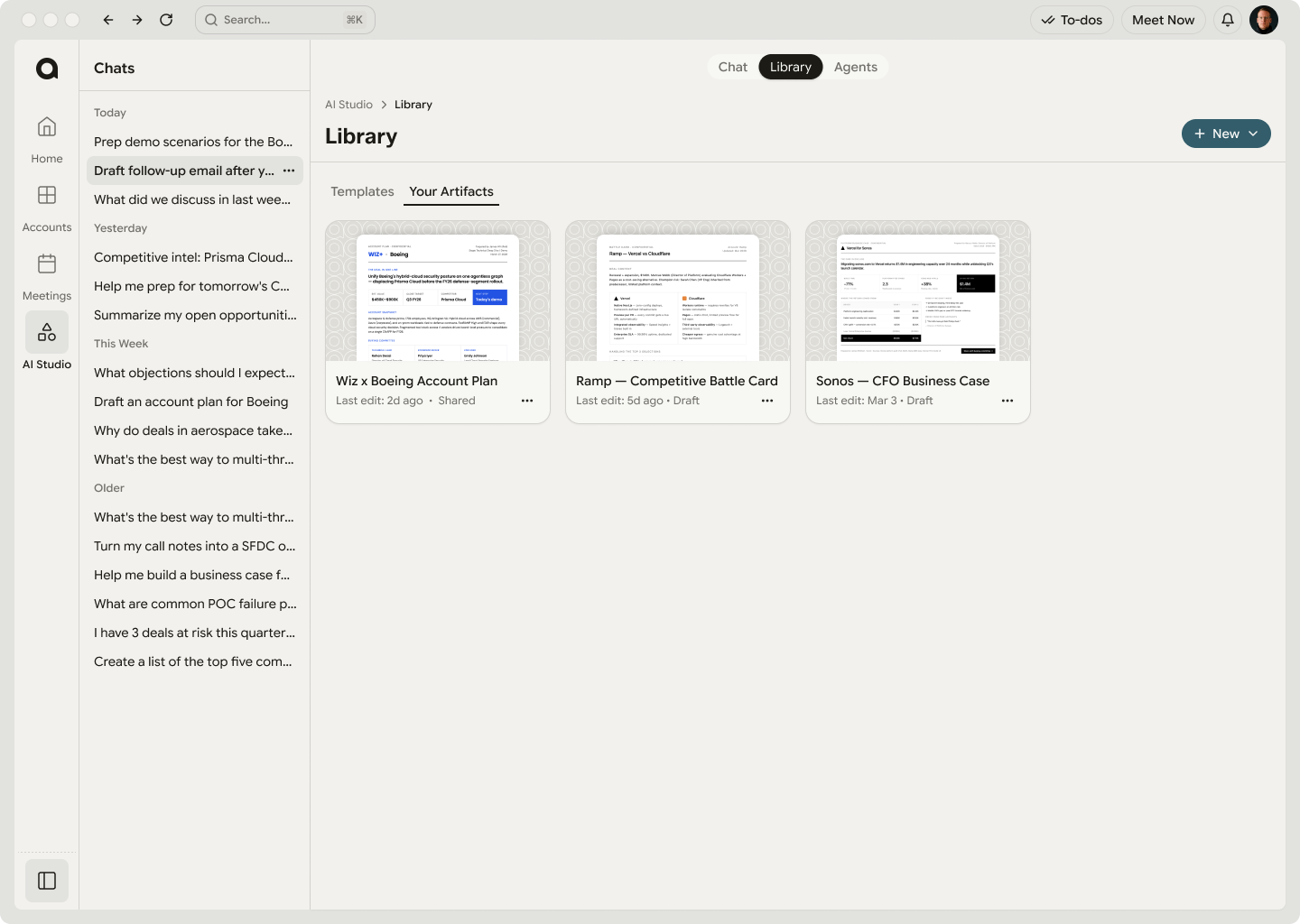
AI Studio is your workspace to ask, automate, and reuse — and everything you make (artifacts, agents, templates) is created right in Chat. Browse what you've built in the Library, and keep an eye on what's running under Agents.

1

Inside the Studio

Chat · Library · Agents
AI Studio walkthrough — asking in Chat, turning the answer into an artifact, then spinning up an agent
Animated demoAI Studio in action — chat → artifact → agent

Chat

Where everything is created. Ask anything, then turn any answer into an artifact or spin up an agent — right in the conversation.

/ saved prompts · @ accounts

Library

Explore your collateral. Everything you make in Chat auto-saves here — browse and share your artifacts, and build reusable templates.

Artifacts · Templates · versioned & searchable

Agents

Track your agent activity. Recurring jobs that run on a schedule or trigger — and every one waits for your approval before it sends.

Run Now · Pause · Edit
Saved prompts aren't a separate place — type / in any chat box to pull them up. Catch yourself typing the same thing three times? Save it from the response with one click.
2

Your agents

Automations that just run
The part that works while you don't

Describe it once — the agent takes it from there

Agents are automations you set up in plain language. Tell one what to watch and when, and it runs on its own — every send still waits for your approval.

1Describe it in Chat — “every Monday, scan my accounts for new signals”
2It runs on a schedule or trigger, pulling from everything you've connected
3You review and approve before anything is sent
4Manage it anytime — Run Now, Pause, or Edit
3

Prompt library

Saved in your Studio

A few to get you started — spanning agents, artifacts, and everyday chat. Copy one into Chat, or save it as an agent so it just runs. The full set lives under / in any chat box.

Agent Sets up automation

Weekly account-signals agent

Every Monday at 8am, scan my top accounts for new signals — news, deal movement, buying-team changes — and post a short digest to my Slack. Ask me before anything gets sent.
Creates an agent you can Run Now, Pause, or Edit.
Artifact Studio template

QBR / Account Deck

Generates a client-ready deck or QBR from your account data — deal status, wins, open items, and next quarter's plan. Assign it to the account, edit inline or by chat, then share a link, download it, or push it to your CRM.

Auto-saves to your Library, versioned.
Chat Pre-saved · Send as-is

Find me my next 10 customers

Based on my closed-won deals and current book of business, identify 10 companies that fit my ICP. For each, name the best contact — the actual buyer, their title, and why they'd care right now. Then draft a short, specific outreach email to each. No generic templates.
AnyTeam infers your ICP from deals you've already won.
Chat Pre-saved · After a call

Draft the follow-up from this meeting

Draft a follow-up email from my last meeting in my voice. Reference what we actually discussed, confirm the next steps and owners, and keep it short. Don't add boilerplate.
Lands in the Follow-up queue — review and Approve to send.
04

To-dos — one list for everything

Every task, one overlay

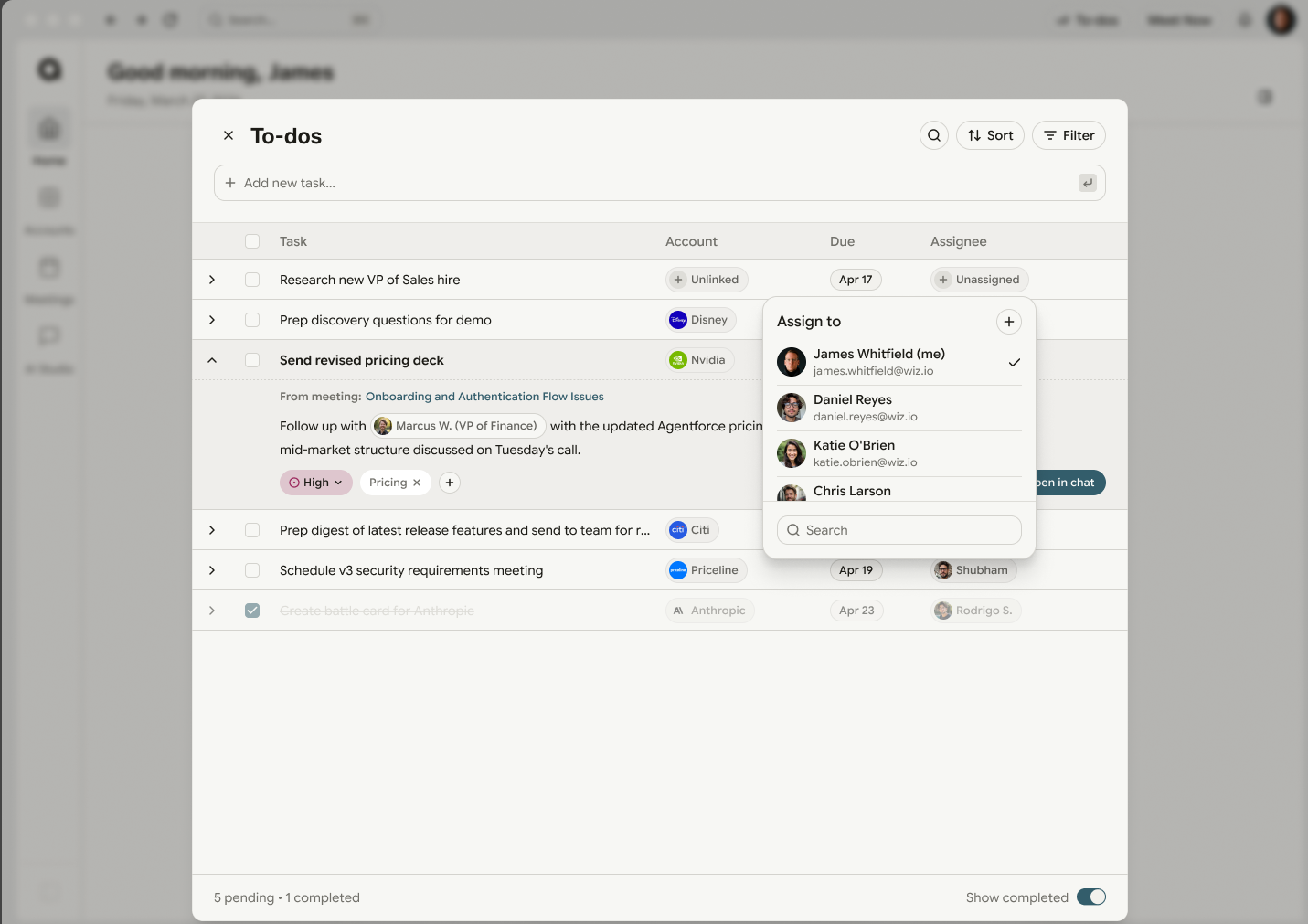
To-dos is your task manager. Every follow-up, action item, and reminder — across every account — collected into a single overlay you can pull up from anywhere in AnyTeam. It fills itself in as work surfaces, so nothing slips between the cracks.

The To-dos tracker — tasks across every account, with due dates and assignees
One overlay, everywhere

Open your to-dos from any screen. Tasks from every account, meeting, and follow-up live in one place — never scattered across tabs.

Captured for you

AnyTeam adds to-dos as they come up — in calls, emails, and CRM changes — so the list always reflects what actually needs doing.

You stay in control

Check off, snooze, or reprioritize. Anything that sends — an email, a CRM update — still waits for your approval.

Straight from your meetings

Never lose a next step

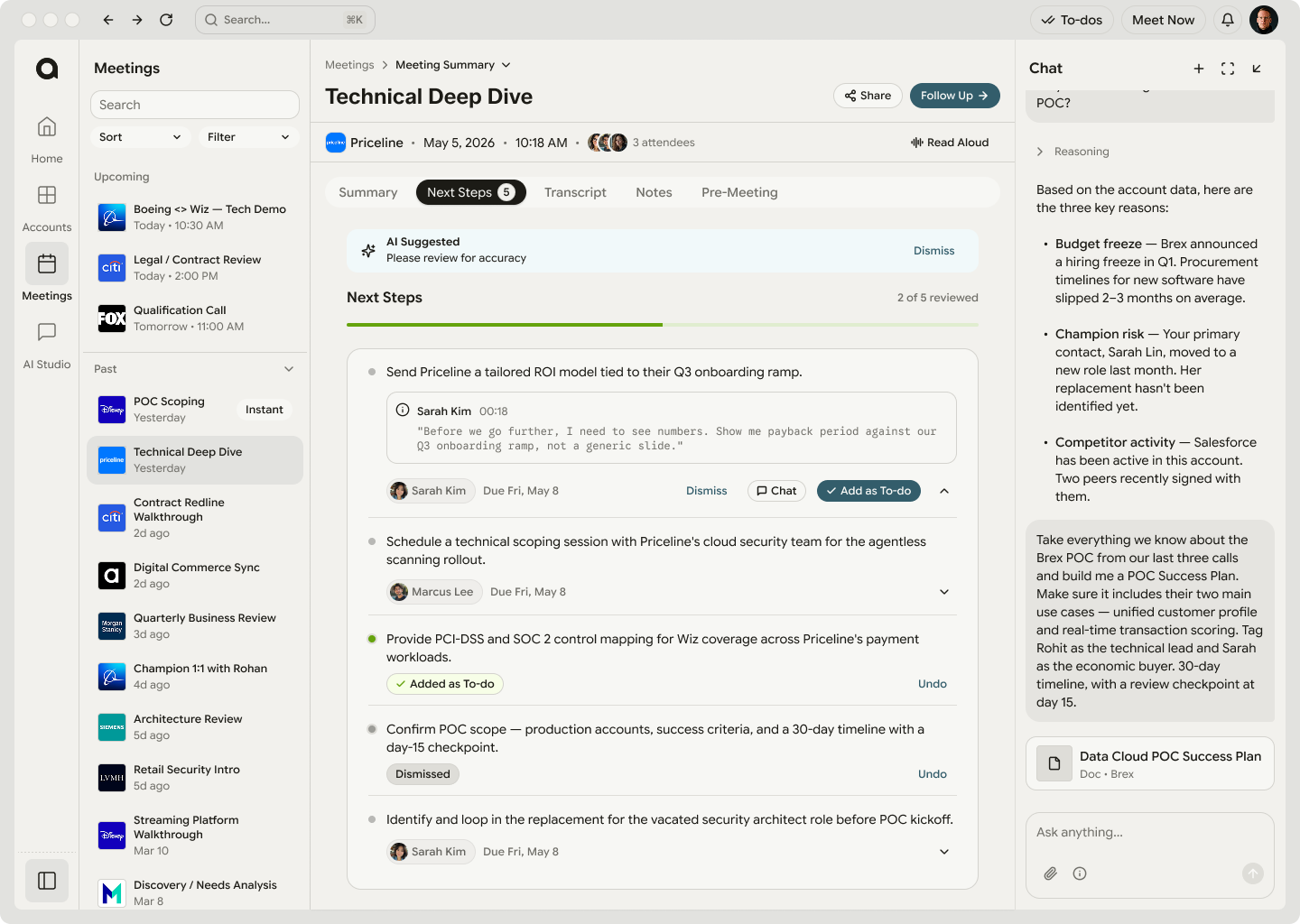
After every call, your Meeting Summary pulls out the next steps, commitments, and to-dos that came out of it. Add any of them to your tracker in one tap — so nothing said in a meeting ever falls through.

  • Next steps and commitments, captured automatically
  • One tap to add to your to-do tracker
  • Dismiss anything you don't need
Meeting Summary Next Steps — each item can be added as a to-do

Want a task to run itself on a schedule? That's an agent, and it lives in AI Studio → Agents. To-dos tracks the work; agents automate it.

05

After a meeting — handled for you

The follow-up, without the busywork

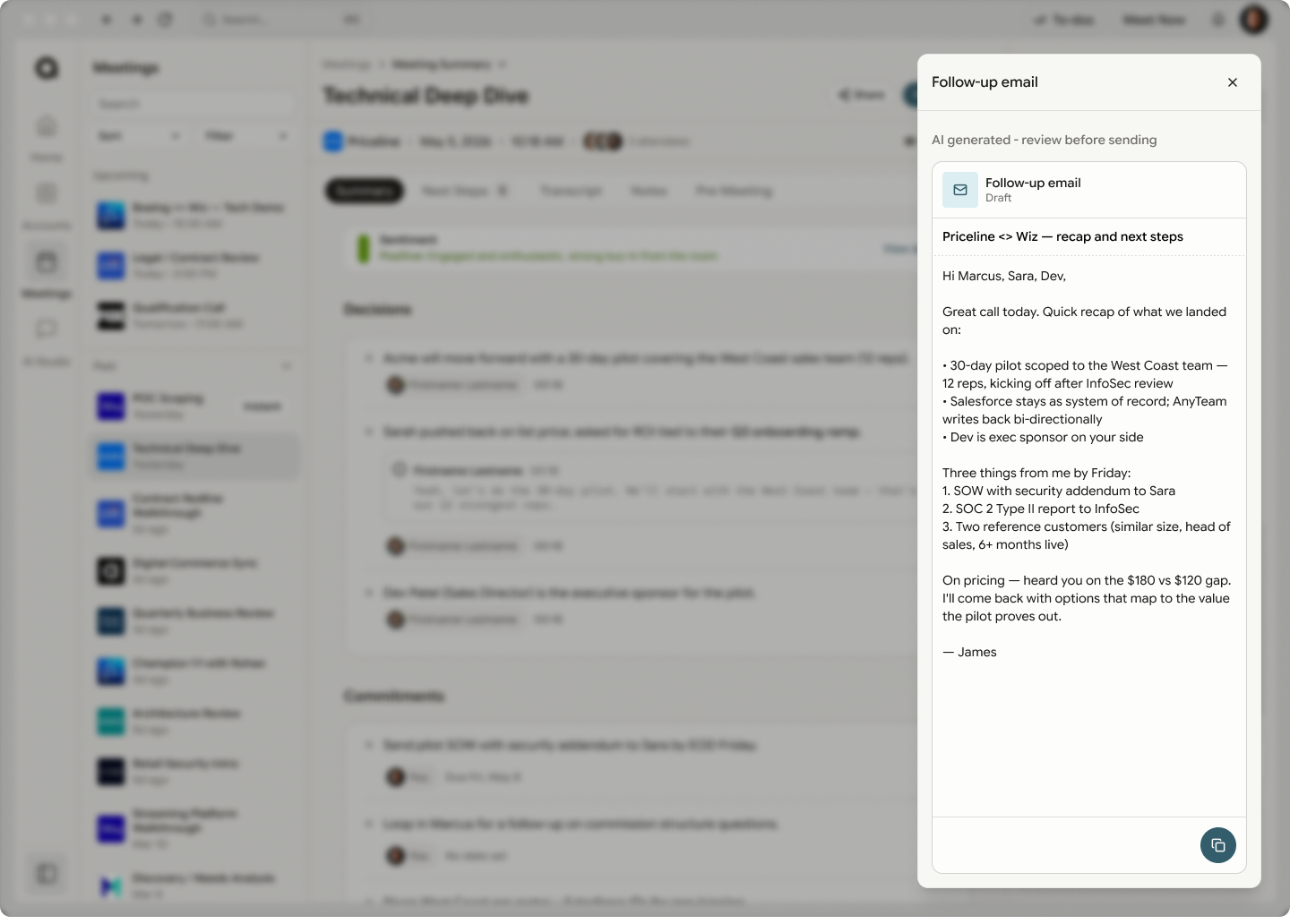
The moment you hang up, AnyTeam gets to work. The recap, the follow-up email in your voice, the CRM updates, and the next-step to-dos are all drafted and waiting. You review and approve — the busywork is already done.

AI-drafted follow-up email, ready to review before sending
Done for you

The follow-up email, already written

AnyTeam drafts the recap email in your voice — grounded in what was actually said, with the decisions, commitments, and next steps laid out. Review, tweak if you like, and send.

  • Recap and next steps, pulled from the transcript
  • Written in your voice — not boilerplate
  • Nothing sends until you approve it
06

Where things live

The whole app, at a glance

Every page, the features inside it, and what quietly powers it all.

Main pages & features

Settings

Settings

Everything you configure, in one place.

ProfileData SourcesNotificationsConnectorsApp Settings
Building your profile in Settings
ProfileAnyTeam builds your seller profile in a quick chat — what you sell, who you sell to, and how you work.
Connectors settings — the tools AnyTeam is connected to
ConnectorsManage the tools AnyTeam is connected to — add, review, or remove them anytime.

Under the hood

Memory

The engine underneath — how AnyTeam learns and gets sharper with every interaction.

Layer 01
Captures

Calls, emails, meetings, CRM updates, Slack messages, docs — recorded and understood as they happen.

Layer 02
Connects

Every signal linked to accounts, deals, people, and patterns — turning scattered noise into one connected graph.

Layer 03
Compounds

Every new interaction makes the whole system smarter — every rep benefits from every past deal, every account, every conversation.

07

Quick answers

Good to know
Does it send emails or update my CRM on its own?
No. AnyTeam drafts and proposes; you approve. Every email, CRM write, and Slack post is queued for your review first.
What does Memory actually remember?
Facts about you and your accounts — your writing style, follow-up cadence, competition, and deals — each with a source and last-updated date. Search, correct, or remove anything in Settings → Profile.
Do I have to connect all my tools?
No — start in Demo Mode if you like. But the biggest jump in quality comes from connecting your calendar and CRM. Add or adjust sources anytime in Settings → Data Sources.
How do I trust an insight?
Everything is source-cited. Insights in briefs and summaries expand to show the exact quote or record behind them.
How do I set up an agent?
Just describe it in Chat (see the Agents tab above). It becomes an agent in AI Studio you can Run Now, Pause, or Edit — with undo for two weeks.
Is my data private?
Content is scoped to your workspace and account. Personal context you add stays private and is never pooled with other users.
Can I share a brief or summary externally?
Yes — AnyTeam generates a customer-safe version that strips internal coaching, risk notes, and private data. Share links are revocable and time-limited.
What's the fastest way to get anywhere?
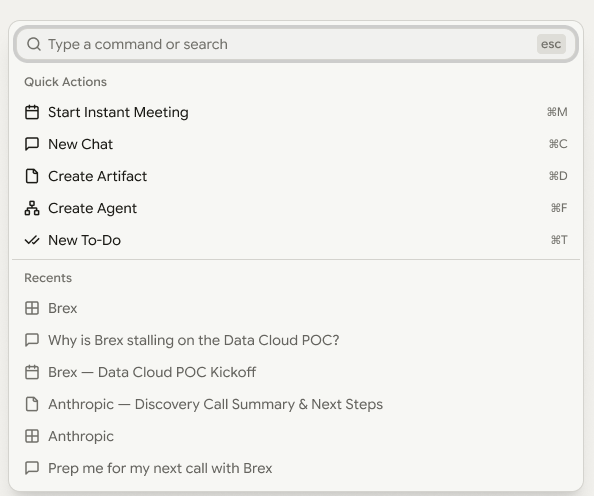
Press ⌘K from any screen to search across meetings, accounts, artifacts, and to-dos, or to launch a creation action.
08

Go deeper

When you want more than the basics
Help Center

Every feature, explained in depth

This guide gets you moving. When you're ready to master a specific surface — Agents, sharing, CRM sync, and more — the Help Center has step-by-step articles for all of it.

Browse the Help Center ↗
Email us
support@anyteam.com
In-app
Ask AnyTeam anything