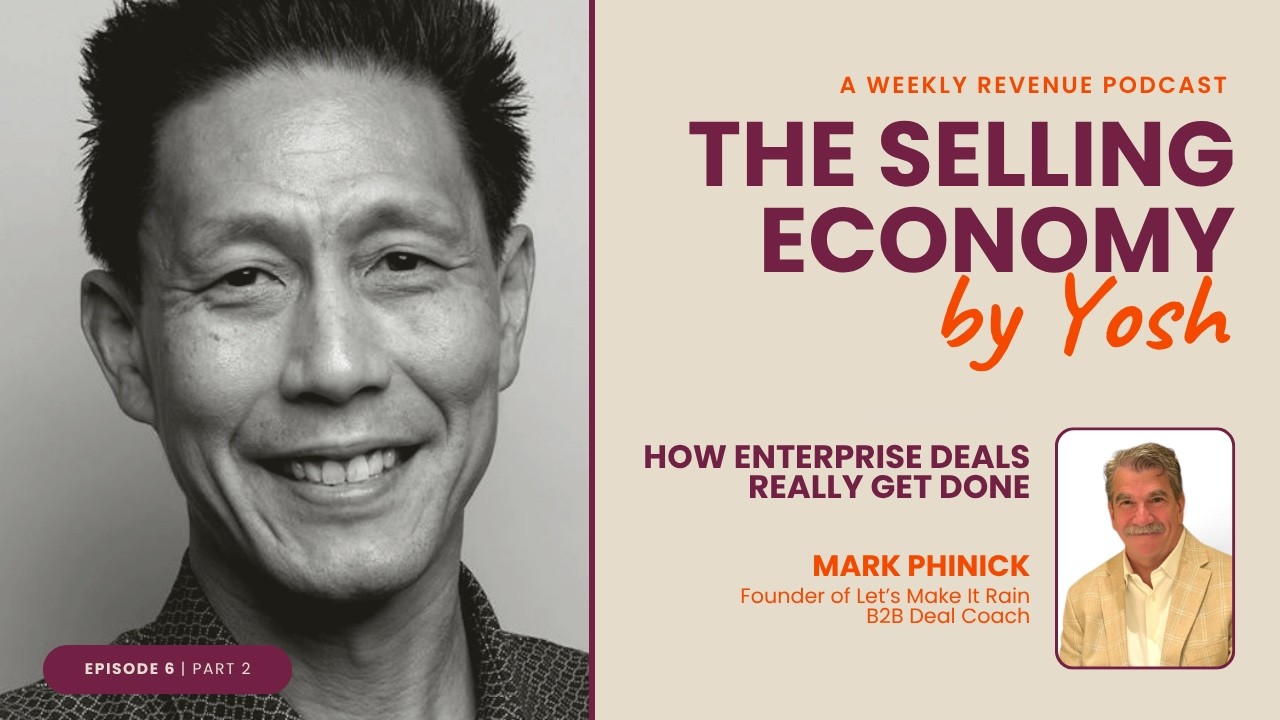
Key takeaways
- Never leave a call without booking the next one. Ask while you still hold something the buyer wants, such as the demo yet to be scheduled, because that is when you have agency.
- Silence is a diagnostic, not a verdict. A single-subject note asking whether to pause invites clarity, and a reply, a refusal or continued silence each tell you where the deal really stands.
- Procurement delays are rarely random. Queues reflect what executives have told their teams to prioritise, so find who owns the decision and what is actually blocking agreement before reaching for a discount.
- Treat public signals as a hypothesis, not proof. Earnings reports, filings, new hires and executive changes shape better questions, but a person still decides which signals matter and what to do next.
Chapters
- 00:00When a Deal Goes Quiet
- 00:47How to Avoid Getting Ghosted
- 02:35Using Silence as a Sales Signal
- 03:33How to Follow Up With Purpose
- 05:44Navigating Procurement and Stalled Negotiations
- 06:44Decision Ownership and Executive Sponsorship
- 08:40How AI Is Changing Sales
- 09:13Using AI to Find Buyer Signals
- 12:12AI Augmented Selling and the Human Role
- 13:05What Sellers Should Do Differently
- 14:29Rapid Fire With Mark Phinick
- 14:50The Dollar Bill Deal Story
- 17:02The Sales Leader Who Changed Mark’s Perspective
- 18:37Who Mark Learns From
- 19:16Where to Find Mark Phinick
Read the full transcript
When a Deal Goes Quiet
0:01 Somewhere out there, right now, a sales rep is walking into a meeting. And sitting across from them is a buyer who already knows more than they do. That's no accident. AI has created the biggest shift in selling in 30 years, and millions of sellers and the leaders behind them are living it every single day. I'm Yosh, and this is The Selling Economy, a show about the people in the middle of that shift, and the stories of what's working now, and the lessons that they've learned along the way. The Selling Economy is presented by AnyTeam, the team behind every rep. Let's talk about what do you recommend? So, you're a rep, or you're a sales leader, you're a founder, a deal goes quiet. What's your prescriptive formula? What do you recommend somebody do? Yeah, so, first of all, you're going to get used to getting ghosted if you insist on leaving meetings without agreeing on a next call.
How to Avoid Getting Ghosted
0:56 It sounds so basic, but I actually have a standing bet with most of my clients. If we talk about an opportunity and you tell me you left the call without scheduling the next one, you have to Venmo me 50 bucks. So, almost all of the reps that I coach have a little posted on their computer, don't leave this call without scheduling the next call, cuz they'll have to pay me 50 bucks. Don't do that, cuz it just invites delays. It invites you getting ghosted. And if it's going to be awkward because they're in a group setting, maybe you're doing a demo, you can't really ask somebody, "Oh, can we schedule our next call?" That's going to be awkward. Well, do that when you're scheduling the demo. Say, "Look, let's Okay, we've got the demo scheduled for Thursday. You're going to need some time to talk with your team. Can I put something on the calendar for the following Wednesday?
1:43 And if you need to change it, we can change it, but at least let's pencil it in." You have something they want, which is the demo. Now is not the time for them to say no. You have agency. So, when you have agency, that's when you ask for things. This is, you know, basic negotiating. But something as simple as getting ghosted can be avoided. Now, when a deal is progressing and somebody misses a meeting or doesn't respond when they're supposed to and you haven't scheduled that next call, which I keep coming back to is so vital. Then you got to figure out where are we in this deal? But silence isn't always bad and you know I wrote this book for a very specific reason. I would get calls from reps. They haven't called me back. They haven't called me back. Well, maybe the contact that you're speaking with is dealing with something personal.
Using Silence as a Sales Signal
2:32 Maybe there was a death in the family. Maybe somebody's sick. Maybe there was an internal fire drill or something that has nothing to do with you or your deal. They have other priorities in their life. You are not the center of their world. So, they they also may not be ready to have that discussion or share with you what's happening inside the company. Maybe they're getting acquired. Maybe they're acquiring somebody. Maybe there's a new boss coming in. Maybe there's a reorg. But what we're looking for at this point is clarity. So, I don't assume just because there's silence that they've lost interest. I actually think silence I use that as a diagnostic. So, I think it was Chris Voss where I first learned this. I'll give him credit cuz he's just a master of this. So, I always recommend a a single a single subject line email. If you're If you're getting ghosted and and it's just it's gone a a little bit too long to where common sense tells you you should have been re- re-engaged.
How to Follow Up With Purpose
3:25 Send a note. Are we still good on your side for this? If priorities have shifted, happy to pause. You've immediately stopped selling, which is you should have stopped a long time ago because you've already delivered the business case. You've already delivered why they should act, right? Sales Sales is not about selling to the end, it's about helping customers buy. So, by saying that you're you're happy to pause, You're telling them, "I'm looking for clarity and if you're not in a position, I have other customers lining up that do need me now." And I will tell you, nine out of 10 times it gets response, if only to get clarity on where you stand. So, another approach that I've been using a lot lately with clients, encouraging clients to do and it's working, is to if you've earned the right to do so, just put something on your future customer's calendar.
4:17 And if they're simply overwhelmed trying to get it done, trying to get things done, they will thank you for keeping things moving. It's a partnership. They have business outcomes that they want to deliver. You have a solution to that. You need each other. So, they may they may simply say thank you and join the call. Then again, they may reply with bad news. "Sorry to inform you, but we're going another direction." Or they may totally ignore it. All of these tell you something. All of these are signals that tell you where your deal is and if needed, unfortunately, sometimes it just lets you focus on deals that can actually close. So, the key is to respect the silence and not just stop sending empty follow-up notes. Following up, wondering how things are.
5:03 Following up, wondering when we're going to get the order. They know your role. They know you're a salesperson. There's no surprises in your respective roles in this in this transaction. So, make sure you're talking about something substantive. They also know there's no downside or punishment if they stay silent. They don't get an electric shock when they ignore an email of yours. It's Pavlovian to where they know that you're just going to keep sending follow-ups and sometimes they're like, "Wow, 20 follow-up notes in two days. Must be pretty desperate. I guess we we know where we're standing on our negotiations. Pretty important stuff." So, watch watch the follow-ups. we've all lived that. Every seller I work with including myself. so you don't do it again. Those are just awesome, amazing tips that I think we we can all apply to practice because at the end of the day, a good AI solution, whether you have something out there, can't actually do that because that's just something that you can only learn by working through these different scenarios.
Navigating Procurement and Stalled Negotiations
5:59 Now, I think the hardest gate to kind of go through is procurement. And I've been on both sides. So, as a buyer of solutions, oftentimes I'm like, "Okay, we have a lot of things to to to focus on right now. I have to to finish off the quarter." And I know that somebody wants to to sell me, and we kind of are officially agreed on a close date. And then I go to my procurement team, and the procurement team says, "Well, hey, Yosh, we're backed up. I can't get you in the queue here, so this is going to have to push to to next to to next quarter." Right? So, I've seen that from my side, and then I've seen it on the other side as being a seller when procurement doesn't respond, when procurement draws out that negotiation, and just lengthens that process. How do you deal with procurement and or when the negotiations just start slowing a deal down? What's your tips for this So, I'll go back to the decision ownership and the requisite to have an executive who's willing to own the process.
Decision Ownership and Executive Sponsorship
6:50 We all know procurement, legal, all these different stages in a sales cycle and stakeholders, they're being told the deals that the executives want done by this time frame. There's nothing random and getting in the queue and there's nothing random about which deals procurement and legal were working on. They've been told to make these deals happen. So, I go back to who owns the decision and are they actively shepherding this thing forward. I think you would agree, I've never seen a deal close without somebody who wants to buy it, so a champion. Nobody buys it cuz they have to, unless you're sole source. I've never experienced that. They There's somebody there that wants to buy, and they want to buy from you.
7:36 They want you to be successful here. I've also never seen a deal close without executive sponsorship. Executives just don't let that happen. So, procurement may be negotiating the price and terms, but before we start giving things away, making concessions, discounting, I want to understand who what's really slowing things down. Who owns that issue? What needs to happen to reach agreement? The goal is to solve that real issue, not default to discounting. That's what procurement wants you to do. And I've seen too many deals reps come in and if we gave you a 30% discount, would you get it done this week? What about 35? Okay, yeah, we can do that. As opposed to saying, well, now we differentiate between do you want to do something and can you do something?
How AI Is Changing Sales
8:22 If the right response to something like that is what? If I could do that, can you get it done? And more to the point, instead of asking a closed-ended question, what would be the remaining steps for you to get it done this week? Once again, now you have agency. So, that's when you have to ask adult Very good, Mark. Excellent. Another fantastic tip for our listeners. Let's talk about AI. We're We're in this world of AI. It's It's changing how buyers buy. You mentioned this earlier, how buyers engage with companies. They are either researching products, doing POCs with various companies, and and being able to to really kind of move through a process where when they connect with a rep, they're already pretty informed. But when you go on the selling side, there's also the aspect of AI.
Using AI to Find Buyer Signals
9:08 And specific to your line of work, your business, how do you see AI fitting into to coaching? Yeah, that's a really timely question. So, I started using GPT, I guess in '22 or '23. And I was using it for what everybody else was using it, really basic stuff. But what it's evolved to now is looking for public signals that suggest that a future customer might already be thinking about solving a problem that my client provides a solution to. We started out years ago with account-based marketing and then things moved over to ICPs and it's one thing to give an organization a list of companies in of a certain size and an industry. It's a whole 'nother to look at a list of organizations that are publicly talking or thinking about the problem that we solve.
10:00 So, we want to look at earnings reports, 10-Ks, 10-Qs for public companies, recent hires, executive changes, funding, grants, expansion, restructuring, new product announcements, other public information. These are These are signals. They're not a proof of a problem or that they're going to buy anything, but they at least give us a hypothesis. They get us closer to wanting to investigate that organization than just saying, "Yeah, this group fits our ICP. They're of a certain size." So, for example, if we see signals that an organization is hiring lots of sales people or they have a new CRO or they're talking publicly about productivity. We can go into the meeting and be prepared with better questions to test whether it's ramp time or onboarding or performance or manager capacity if those are issues and and if they are, well, what might they be costing us every day that it goes unresolved?
10:59 Or a signal start to show pressure around retention or growth or margins. All this is in the 10-Ks. It's in the earnings reports and in the 10-Ks. We can prepare questions around where revenue might be leaking or costs are are too high and try to identify what they're trying to improve and who owns it. One of the things I'm eternally grateful for with my time at IBM was how much training I got on how to read 10-Ks, 10-Qs, earning reports, analyst reports and then I I routinely integrate that into my coaching. So, the goal isn't to walk into pretending that we know an organization's business better than them. It's to understand the business well enough to have a relevant point of view and to ask better questions. We're not talking about products. We're talking about how to help the organization improve their business.
11:47 So, AI makes all of that so much easier, so much faster. And the prompts that I've built over the last couple years have just gotten better and better and better where we're finding exact fits for organizations. So, a human still has to be involved to decide which signals matter, which ones are timely, they have a shelf life, they have to be there to test the hypothesis with a customer and then figure out what to do next. Well, that's spot-on and super aligned to what I'm trying to build at Anyteam is sellers are always going to be part of the equation, but the things that AI should just automate or put in self-driving mode is just there for the AE. And then whatever you can now kind of augment with with the use of agents that can assist in task and things that need to get done to be able to give sellers more selling time back.
AI Augmented Selling and the Human Role
12:36 That's essentially kind of what we've constructed at Anyteam and why we we frankly have started this this podcast and why we started the company and why we built built Anyteam is is because we see that the the new world of selling will still involve people. It has to involve people, but it will be either AI augmented or AI enabled, but it won't be a replacement. So, what you said is super aligned with with the way that that we're thinking about things. So, thank you for for those those that that that commentary. Yeah, my pleasure. So, I think our last question is Mark, you you've done all this coaching, you wrote a book. We're going to have listeners here listen to this fantastic dialogue. What do you want sellers to do differently after hearing after hearing this or after reading your book? So, first and foremost, stop confusing interest with the decision.
What Sellers Should Do Differently
13:23 Don't forecast deals just because you or your manager needs it to close or you think it should, that's not what's going to drive a deal. You're just going to set yourself up for being yelled at. Please don't leave a mess don't leave a meeting or a call without scheduling your next one. I'm very fortunate you actually were not only am I engaging with founders and and CEOs and sales leaders who want to convert more pipeline deals, but a lot of the reps who were on teams of mine at IBM and HCL, it's just so gratifying. They've reached out to me and they want me to coach them in their current roles. So, and some of them have continued education funds that they can use to offset my retainer. So, give me a call. The reality is we need to help reps understand what's driving customers to change, what happens if they don't, what they need to see for a better outcome, who owns the decision, whether that champion can defend it when you're not in the room.
Rapid Fire With Mark Phinick
14:24 And if you don't know how to do this, that's where I ask you to give me a call. That's where I live. That's awesome. So, we're going to end with and at the very end I'm going to ask you to just kind of tell people where they can find you, but I end with three questions. And then I call it rapid fire. So, you might have talked about some of this as as part of this this dialogue here, but your your favorite moment in in sales. You have a long history. What is that one thing and what stands out most? And it could be that deal that that we talked about It's not that deal, but I'll give you another one. And I'll be very quick. So, I was I had met a CISO at an event and they told me that their team was looking at another vendor's product, but things were not moving as quickly. They asked me to come in and present. I did. Everybody said, "Oh, you're the right solution. We want to go with you." We did a proof of concept, everything worked great, and came time to do business and I was told it's not going to happen on the day of the last day of the quarter.
The Dollar Bill Deal Story
15:19 So, in the morning, it's not going to happen. Okay, I accepted that. It's going to happen next quarter. I worked with them. 90 days later, all set. We're all set to do business. And I get a text. Mark, you're $300,000 higher than we can work with. We'll have to do it next quarter. Well, fool me once. I've already seen this behavior. I said, I'll be there in 20 minutes. Got in my car, drove to the client. They kept me waiting an hour. I sat in the lobby. And then when he finally came out, he greeted me, took me to his office. Mark, what do you want to talk about? Like, what do you think we want to talk about? We're supposed to do business. Your project's getting delayed. And we're supposed to do business. And he looked at me with the best question, the best lesson. He said, Mark, do I have your best price?
16:06 And Yos, this is the honest-to-god truth cuz he still has it. I took a single dollar bill out of my pocket. I wrote my home phone number on it. This is when we had landlines. Wrote my home phone number on it. And I gave it to him. I said, now you have our best price. That's my home phone number. You call me 24/7 if you ever have an issue. He pivoted in his desk, hit enter, processed the purchase order. And he still has that dollar My gosh, that is a super cool story. Wouldn't happen today cuz we all have digital currencies. Yeah, right. I'd have to Venmo him. Yeah, yeah. Venmo him a dollar with I don't know how that would work. No, he's he still has it though. It's it's really funny. Yeah, that that's fantastic. My next question, second question is your favorite either rep that worked for you, favorite person that you worked for.
The Sales Leader Who Changed Mark’s Perspective
16:58 What's the one thing that you either learned from them or what's the one thing they did that was special? I'm very fortunate, Yos. I've worked for some some of the very, very best leaders. The very, very best leaders. And I'll just share with you it's really not business related, but I'll share with you what one particular sales leader did that probably had the greatest impact on me and really motivated me. When he would come into town, I live in Chicago, when he would come into town, he would make a point of saying, "Mark, I got to go buy some jewelry for my wife. I want you to come with me." So, we would go to Jewelers Row on Wabash and he would take me up and the guy would pull out diamonds, big diamonds. What did I know from diamonds? I was 30 years old. What did I know from diamonds? And he said, "You know what?
17:44 And have him try on a Rolex." I'm like, "Phil, I can't I can't I'm not going to afford a Rolex." "Try it on. Try it on." And I don't know what a Rolex cost at the time. But, what he was doing was exposing me to what many sales people aspire to, which are material things and wealth and what you what you learn over time is it's not the money that you earn that you're after, it's the freedom that money buys. And he just at the time, yeah, started buying Rolexes. Um and I started buying nice cars. Now, I recognize the money that you earn, you should be focusing on experiential things, making sure that your family's taken care of, making sure that your longevity is taken care of, your health is taken care of, and use the money for good. Find ways to pay it forward.
Who Mark Learns From
18:30 Well, in many ways, what you purchased back then might be worth actually more. So, you could treat it as an investment. I will share with you I do. That's awesome. And then my final question is one person that you think would be a a great guest to have on the show next. My goodness gracious. I'm sure you have a roster of people, so Yeah, so the people that I listen to, I listen to Chris Voss a lot, Chris Orlob, Jamal Rhymers. These These are all top sales leaders and you can find them on LinkedIn and whether they're on your show or not, you should be Everybody [clears throat] should be following these people. I learn from these people every single day. Some of them do sales coaching, some of them might actually do deal coaching, but those are those are people that I just absolutely love to follow because I learn something by reading their their post every single That's awesome.
Where to Find Mark Phinick
19:16 I definitely have listened to a few episodes from a number of those those gentlemen and I think they'd be fantastic guests that to have on on the show. So, Mark, this is amazing. Thank you so much. Tell the audience where they can find you. Is it LinkedIn? Is it Do you have a website? Where can they find your book? Yeah, you can LinkedIn is fine. LinkedIn is fine. My name is m a r k p h i n i c k. And if [snorts] you want to go to my website and schedule time with me, let's make it rain.net. So, Mark, thank you so much for being a guest. It was amazing reconnecting the dots from our shared history and excited to continue the relationship here as we enter this new kind of chapter of of both our lives. Yeah, wishing you continued success. You deserve it. Thank you, Mark. That's the show.
20:03 If this one sharpened how you think about selling, send it to one person on your team who should hear it. Follow the Selling Economy wherever you get your podcast and subscribe on YouTube so you never miss a conversation. To learn more about AnyTeam, visit anyteam.com. New episodes every Wednesday. I'm Yosh. So long. Thanks for listening.