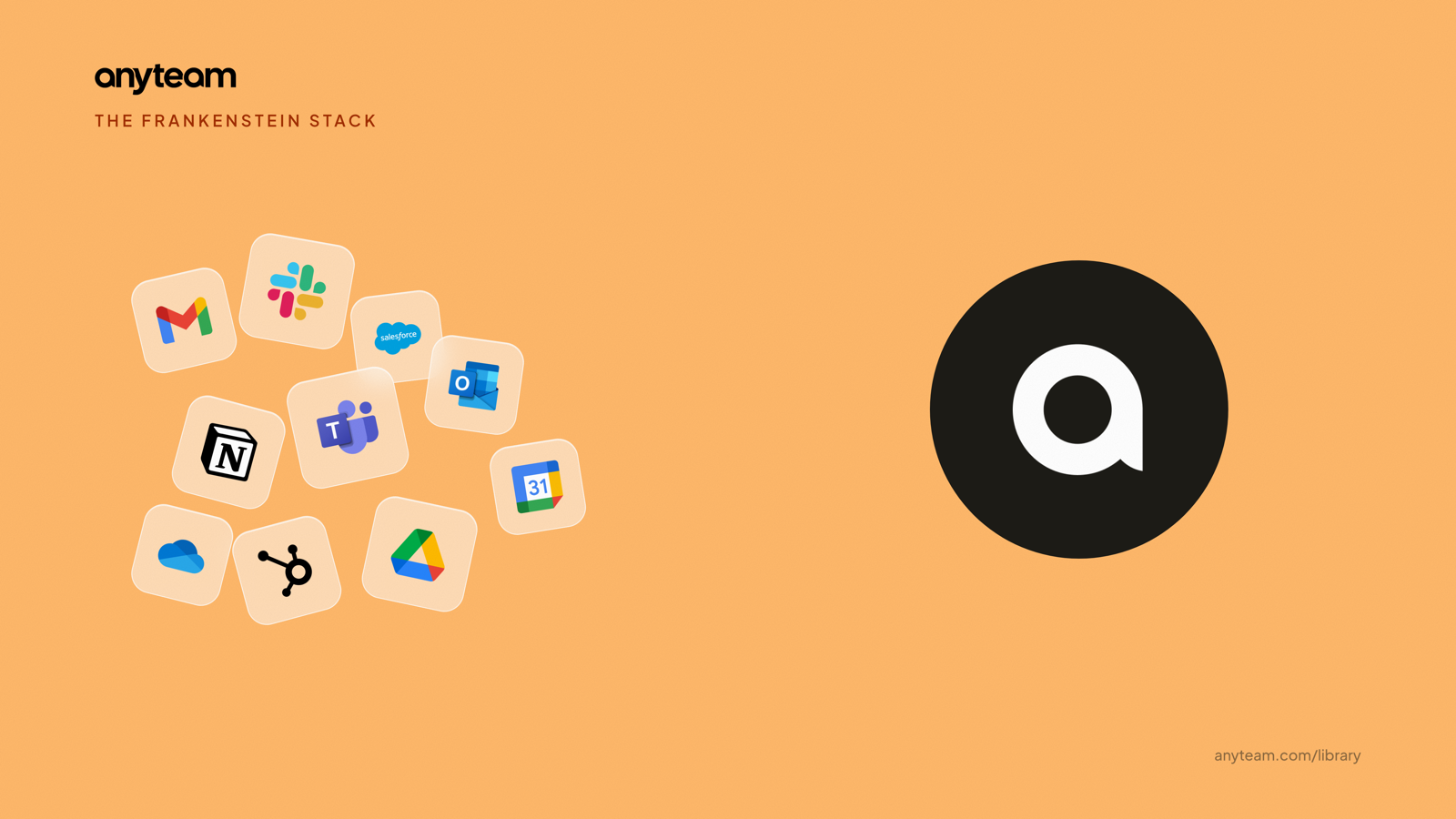
Most sales orgs “doing AI” have accidentally built the same thing: 10–12 disconnected tools, none of which talk to each other, held together by the rep’s patience. A notetaker here. A copilot there. A ChatGPT tab with a folder of pasted prompts. A homegrown script someone in RevOps wired up before they left.
We call it the Frankenstein Stack. And it’s the single biggest reason AI hasn’t moved the number for sales teams yet.
How the Frankenstein Stack happens
It isn’t carelessness. It’s survival.
Buyers moved fast — they now research, compare, and shortlist before a rep is ever in the room. Reps reached for whatever was in arm’s reach to keep up. One tool for notes. One for outreach. One for research. A browser tab for everything else.
The stack is what coping looks like.
What the Frankenstein Stack actually costs
Every tool is another login, another silo, another thing that forgets the deal the moment you switch tabs.
The “memory” lives in one rep’s chat history — so it doesn’t show up for their manager, doesn’t transfer when the deal gets reassigned, and walks out the door the day they leave. You’re not compounding knowledge. You’re renting it, per seat, per session.
Here’s the tell that should bother every sales leader: if bolting AI onto the old stack were working, sales wouldn’t still cost this much. Sales and marketing eats roughly 47% of revenue at leading public software companies. Around 70% of a rep’s week goes to non-selling work. The headcount keeps climbing. The ramp keeps slowing. The tools multiply and the number doesn’t move.
Why you can’t prompt your way out
This isn’t a problem better prompting fixes — even the companies building the models hit the same wall.
Anthropic makes the models, and still had to stitch together 10–12 separate tools to support their own sellers. Miro built 200+ custom GTM skills — but who owns the token costs, the security, the access? And what happens when the engineers who built it all leave?
A raw model isn’t a system. Someone still has to build it, secure it, and keep it alive.
What to build instead
Winning isn’t a tooling project. It needs a purpose-built system the org actually owns:
One memory underneath everything — not twelve. A system that gets sharper the more the team works in it. Knowledge that survives turnover as company IP, not a chat history that leaves with the rep.
That’s what AnyTeam is: a company brain for selling, with a team of agents running on top of it, in the flow of the tools your reps already use.
We didn’t set out to build features. We set out to kill the Frankenstein.
Don’t DIY your AI. Request access →
FAQ
What is a Frankenstein Stack in sales?
A Frankenstein Stack is a patchwork of 10+ disconnected AI and sales tools — notetakers, copilots, chat tabs, custom scripts — each solving one slice of the job, none sharing context, stitched together manually by reps.
Why do DIY AI sales stacks fail?
Because every tool is a separate silo with no shared memory. Context has to be re-entered constantly, insights live in individual chat histories instead of the org, and the whole system depends on the people who built it staying.
What should sales teams use instead of multiple AI tools?
A single system with one shared memory layer — a company brain — that holds account context, deal history, and team knowledge, with agents that act on it inside the tools reps already use.