Reps spend about 28% of the week actually selling. The other 72% goes to admin — and that ratio, not the cost of the people, is what makes sales-led growth look expensive.
Get a few operators in a room and ask which go-to-market motion is more efficient, and product-led growth will win the vote before you’ve finished the question. The reasoning is easy to follow. Software scales for free while people don’t, so a product that sells itself costs almost nothing to serve one more customer, where a sales team costs salaries, ramp, and quota every quarter. That math is why sales-led growth so often gets filed under “expensive, but necessary for the big deals” — the motion you put up with until you can build your way around it.
It’s a clean story, and it holds up right until you look at the number underneath it. What actually weighs on sales-led growth has almost nothing to do with what a rep costs and almost everything to do with how a rep spends the week. Once you see where the hours go, the problem starts to look less like something wrong with your people and more like something wrong with the job we’ve built for them.
The problem was never the selling
It begins with a number that quietly reframes the whole thing. Reps spend only about 28% of the week actually selling — meeting customers, moving live deals, and prospecting for the next ones. The remaining 72% disappears into admin: the internal meetings and one-on-ones, the enablement sessions, the CRM updates, and the steady operational upkeep that gathers around every deal.1
| Where a rep’s week goes | Share | What it covers |
|---|---|---|
| Selling time | 28% | Meeting customers and prospects, and prospecting for the next ones. |
| Admin | 72% | Internal meetings, one-on-ones, enablement, CRM updates, research, prep, and follow-up. |
Source: Salesforce, State of Sales. Reps want to sell; the week keeps finding other uses for their time.
None of this is a knock on reps; if anything it’s the reverse. Your strongest sellers are losing three-quarters of the week to work that keeps them from the one thing only they can do, and that time isn’t vanishing into idleness so much as being absorbed by the system around them — which happens to be the one part of the equation you can actually change.
Start with a rep’s week
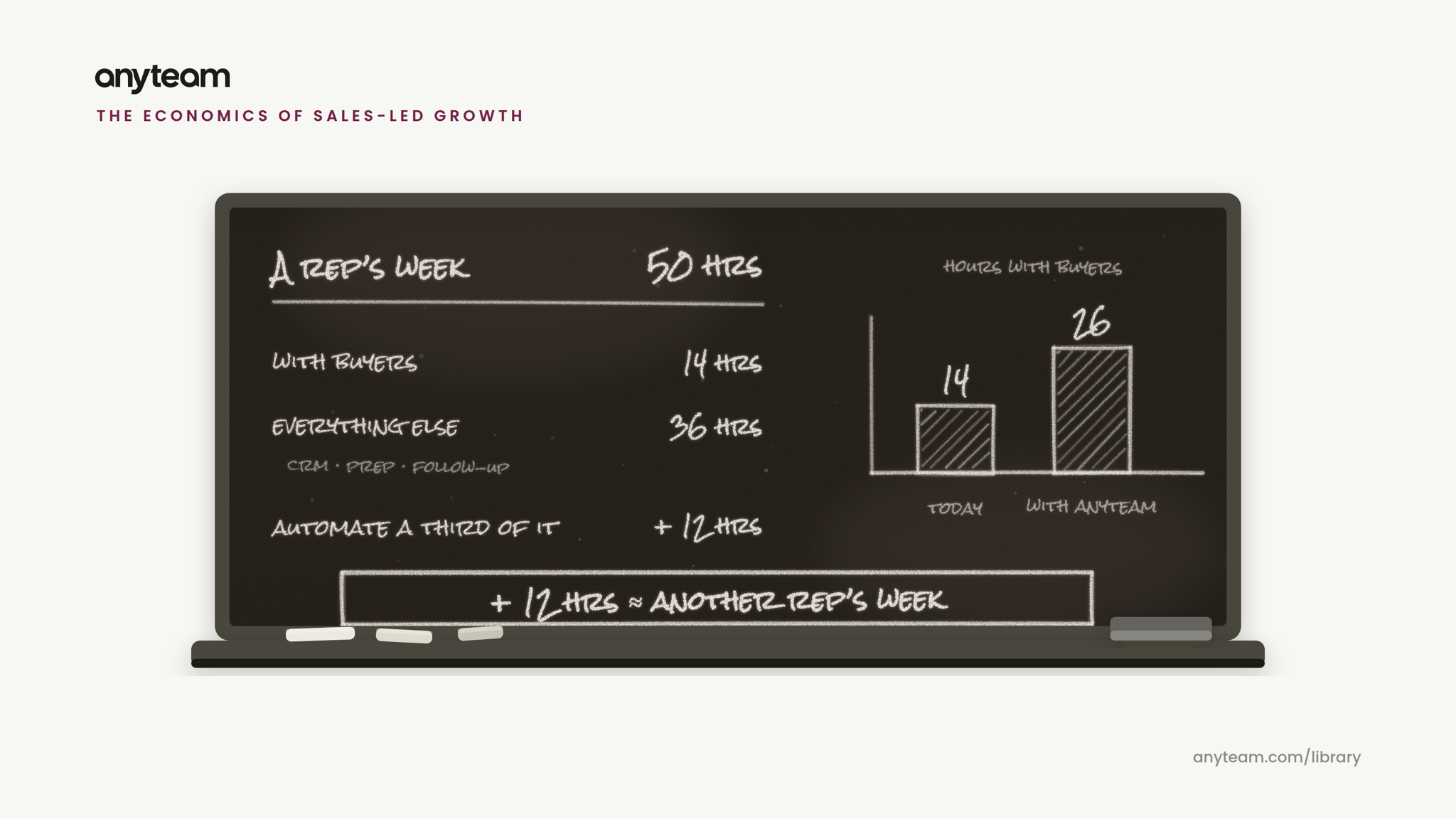
Before any of this becomes a percentage, it’s simply a week, and if you sell for a living it’s a week you’ll recognize. You come in on Monday intending to sell, and by Friday maybe fourteen of your fifty hours actually reached a buyer. Everything else went to the work that surrounds the selling — updating the CRM, prepping the next call, chasing an answer out of marketing, and sitting through the meeting that exists mostly to prepare for another meeting.
Fourteen hours is the whole of a selling week, and no rep ever signed up for that ratio. Nobody takes the job to spend three days out of five on upkeep, but it accumulates all the same, one small task at a time, until the calendar is full and the pipeline is not.
Now imagine most of that work quietly handled for you, with the research finished before the call, the CRM updated without a click, and the follow-up already drafted and waiting. Give the admin to a system built to carry it, return even a modest slice of that time to selling, and the same week takes on a completely different shape.
| A rep’s 50-hour week | Today | With AnyTeam | Change |
|---|---|---|---|
| Selling time | 14 hrs | 26 hrs | +12 hrs |
| Admin | 36 hrs | 24 hrs | −12 hrs |
| Weekly selling time gained | — | +12 hrs | per rep |
Hand back just a third of the admin and selling time nearly doubles, climbing from 14 hours to 26. Same rep, same salary, no new hire.
To the rep living it, this was never really about a figure on a dashboard. It’s the difference between a week spent writing down what happened and a week spent making it happen, with the same person finally pointed at the work that drew them to the job in the first place.
The same shift, one level up
Step back from one rep’s Tuesday to the whole team, and those same twelve hours begin to read very differently. Across the floor, selling time climbs from 28% of the week to 52% — an 86% increase in time spent in front of buyers — while the admin load falls by a third. For anyone carrying a number, that single row is the entire argument for sales-led growth.
| The shift on one rep | Today | With AnyTeam | Change |
|---|---|---|---|
| Selling time | 28% | 52% | +86% |
| Admin | 72% | 48% | −33% |
| Selling capacity reclaimed | — | ≈ 0.9 rep | +0 headcount |
Reclaim a third of the admin week and every rep gives back close to nine-tenths of a rep’s worth of selling, with no req to open and no ramp to wait out. That’s the thinking behind the New Selling Economy: you grow by selling more, not by hiring more.
FAQ
What is sales-led growth?
Sales-led growth is a go-to-market motion where people, rather than a self-serve product, carry the deal. Reps source, qualify, and close, usually for higher-consideration purchases that call for a real conversation and a relationship before anyone signs. It tends to win the largest and most complex deals, which is also where its reputation for being resource-heavy comes from.
Isn't sales-led growth simply more expensive than product-led growth?
On paper it looks that way, since a sales team costs salaries and ramp while a product scales on its own. The catch is that most of that spend never reaches selling in the first place; it covers the 72% of a rep's week that gets eaten by admin. Recover that time and the economics change without changing the model, because the same team sells far more while the deals only a person can win stay firmly on the table.
Where does the other 72% of a rep's time actually go?
Into the work that surrounds selling rather than the selling itself: internal meetings and one-on-ones, enablement, CRM updates, research, prep, and follow-up. Very little of it genuinely needs a rep's judgment, and almost all of it can be carried by a system that remembers the account, which is exactly what frees the rep to sell.
Does giving reps their time back mean hiring fewer reps?
It means getting far more selling out of the reps you already have. Reclaiming even a third of the admin week adds close to a full rep's worth of selling capacity per person, so the same headcount covers more pipeline and you hire to grow rather than to keep up.
How does AnyTeam give reps their selling hours back?
AnyTeam is the AI workforce for revenue teams. It sits on top of the tools your reps already use and takes on the admin — research, prep, CRM hygiene, follow-up — grounded in a shared memory of your product, process, and customers. The busywork gets handled in the background, and the rep's week goes back to selling. You can see how it works at the New Selling Economy.
Notes & sources
- Salesforce, State of Sales — reps spend roughly 28% of their time actively selling, with about 70–72% going to admin work such as internal meetings, enablement, and data entry. salesforce.com
The per-rep figures are an illustrative model, not a benchmark: they apply the cited 28% / 72% split to a 50-hour week and assume one-third of the 36 admin hours (12 hours) is reclaimed and redirected to selling. Selling then rises from 14 to 26 hours — a move from 28% to 52% of the week, an 86% increase. Those 12 reclaimed selling hours equal about 0.9× a rep’s original 14 hours of weekly selling.