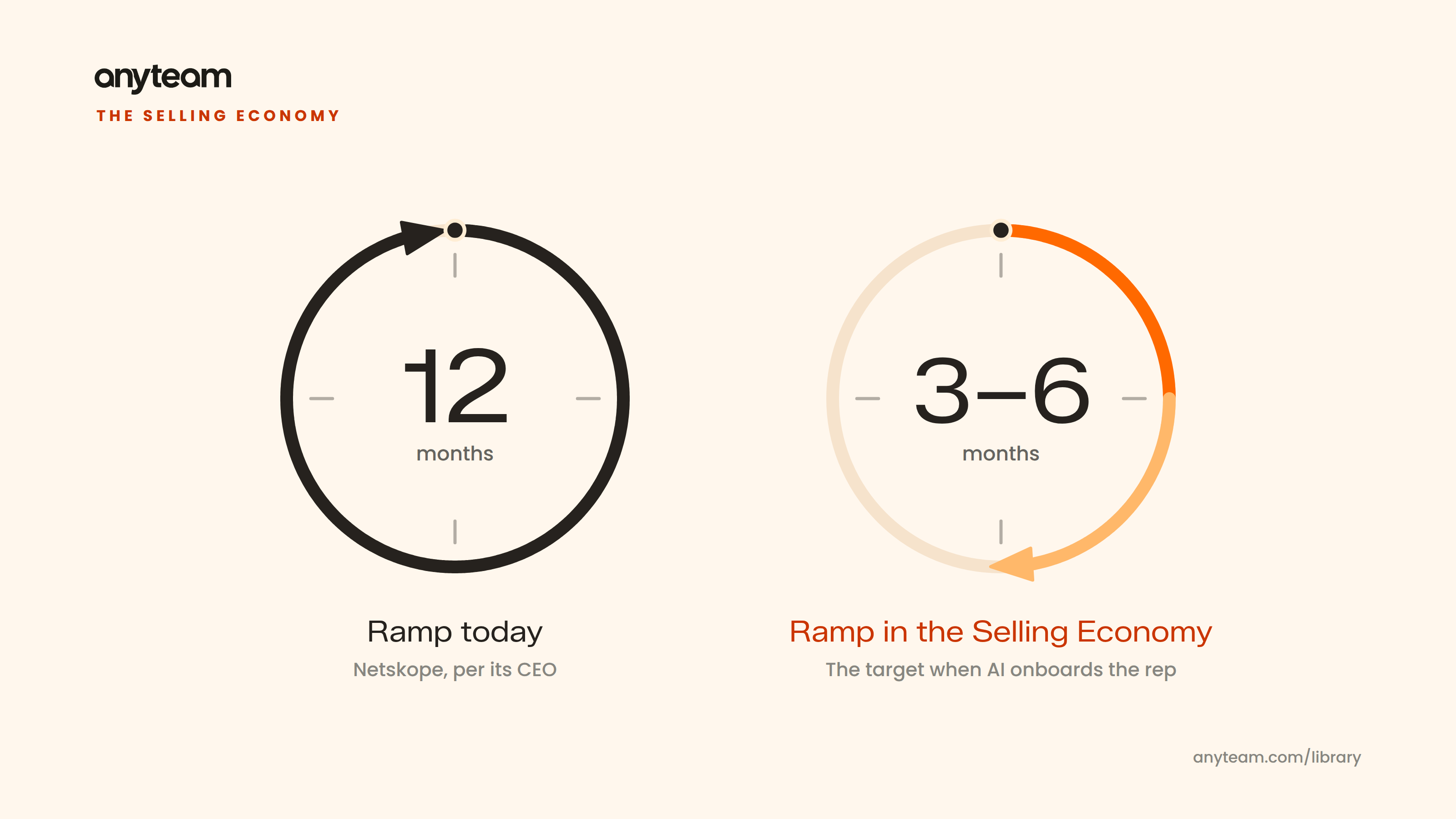
Sanjay Beri, co-founder and CEO of Netskope, said on the Q4 FY2026 call that the company is building for the AI world, but “it takes about 12 months for them to ramp to full productivity.”
On September 2, 2026, Netskope reported a strong quarter: annual recurring revenue of $899 million, up 27%, and net revenue retention up to 114%. Five AI security products launched since the start of the fiscal year, with pipeline building behind them. On the earnings call, an analyst asked the obvious question: what accelerates net new ARR from here?
Beri told the analyst that “AI security deals will close in the back half,” and then continued: roughly half of Netskope’s quota-carrying reps are still ramping, and ramp takes about a year.
This is the classic and most prominent Selling Economy problem: long AE ramp times. According to Seismic, the average sales rep ramp-up time is six to nine months, which shows how long it can take new sellers to reach productivity.
Despite being a company at the centre of the AI supercycle, growth is gated by the oldest constraint in enterprise sales: how long it takes a person to become productive.
Every CRO runs on the same clock
For the past thirty years, companies have largely created sales capacity the same way. Hire a rep, give them a territory and a quota, and wait for them to become productive. That is the selling economy every CRO knows. AI is now changing the work those reps do, but it has not yet changed the underlying model.
How long does it take an enterprise sales rep to become productive at Netskope?
About 12 months.
On the Q4 fiscal 2026 call in March, Beri said the company started hiring and ramping reps in earnest around the middle of the prior year, and that “it takes about 12 months for them to ramp to full productivity.”
Netskope’s 10-K says the same thing in risk-factor language. “Our sales cycle is long and unpredictable” is listed among the principal risks, and the filing adds that new hires need significant training and time before they are fully productive.
Why does ramp take so long?
Because becoming productive means running the whole enterprise sales process end to end.
A new rep has to find the opportunities and get the meetings. They have to become experts in the product, the market, the competition, the use cases, their accounts, and the company’s own sales process. After that comes the proof of concept and procurement. Only then do they close.
If an organisation runs CRM tools like Salesforce with bolt-on AI features, reps are not really doing anything different from what they did before. They are using AI to speed up tasks like drafting emails and summarising meetings.
Has AI changed the economics of selling capacity?
Not yet — and not at Netskope.
AI has changed the work of selling, but it has not yet changed the economics of sales capacity, ramp time and sales productivity. If Netskope’s AI adoption is accelerating, one might think it should no longer take a new rep 12 months to become fully productive.
The thesis behind becoming a Selling Economy company in the AI era is that new metrics emerge for running the business:
- Faster rep ramp time
- Reduction in non-selling time
- Increased sales productivity
If those held at Netskope, ramp time would be three to six months rather than twelve. Reps would gain five to ten more selling hours each week, and the sales team would hit aggressive targets faster.
How AnyTeam solves this problem
Sales ramp time is a problem AnyTeam solves.
AnyTeam’s AI Revenue Workforce is built around a knowledge graph and a memory system that can onboard new reps in real time, including account and territory debriefs with the full history of the account drawn from meetings, CRM data and more.
AnyTeam’s autonomous agents prep reps for every interaction they have with prospects and customers. AI chat answers questions and gives feedback in the moment. Agents can be built for sales coaching and for your sales methodology. And during meetings, AnyTeam’s meeting pilot gives real-time guidance so reps can address questions as they come up.